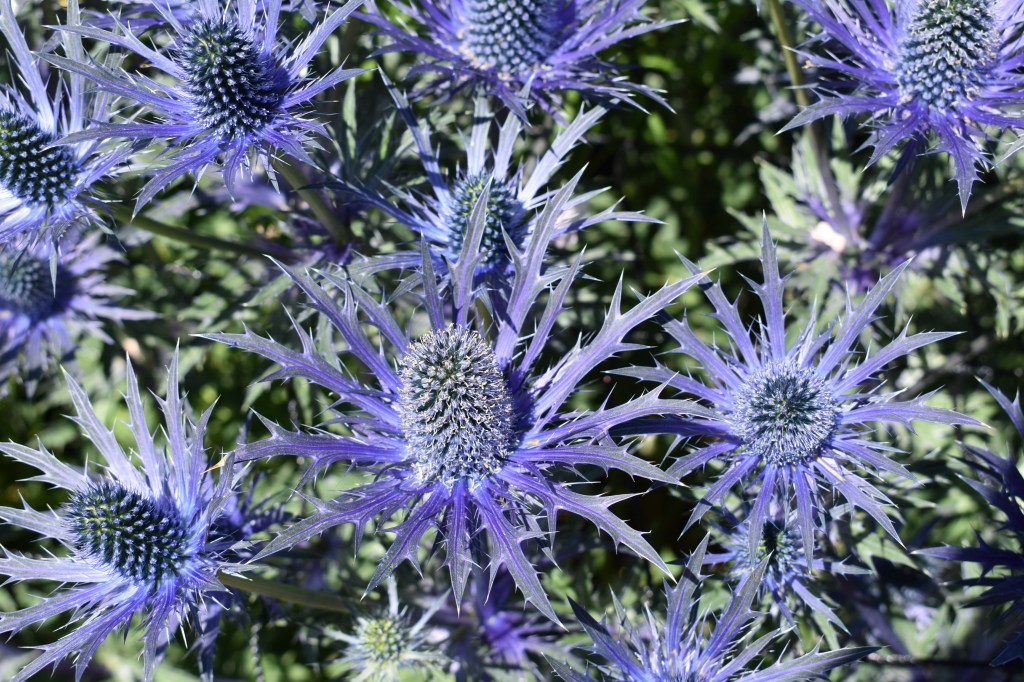
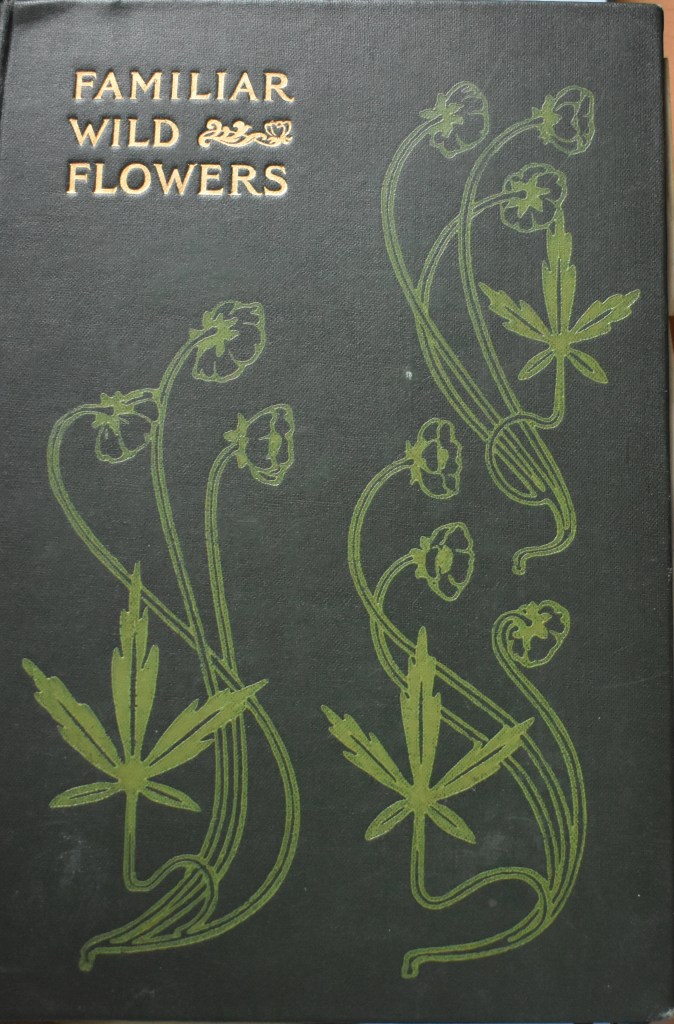
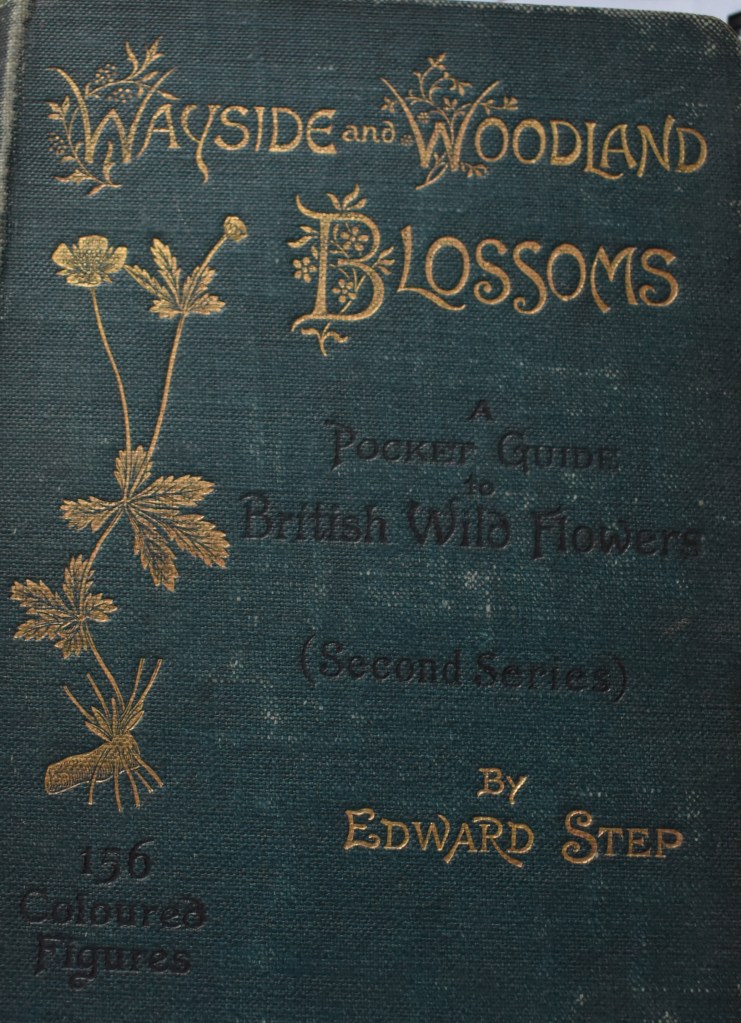
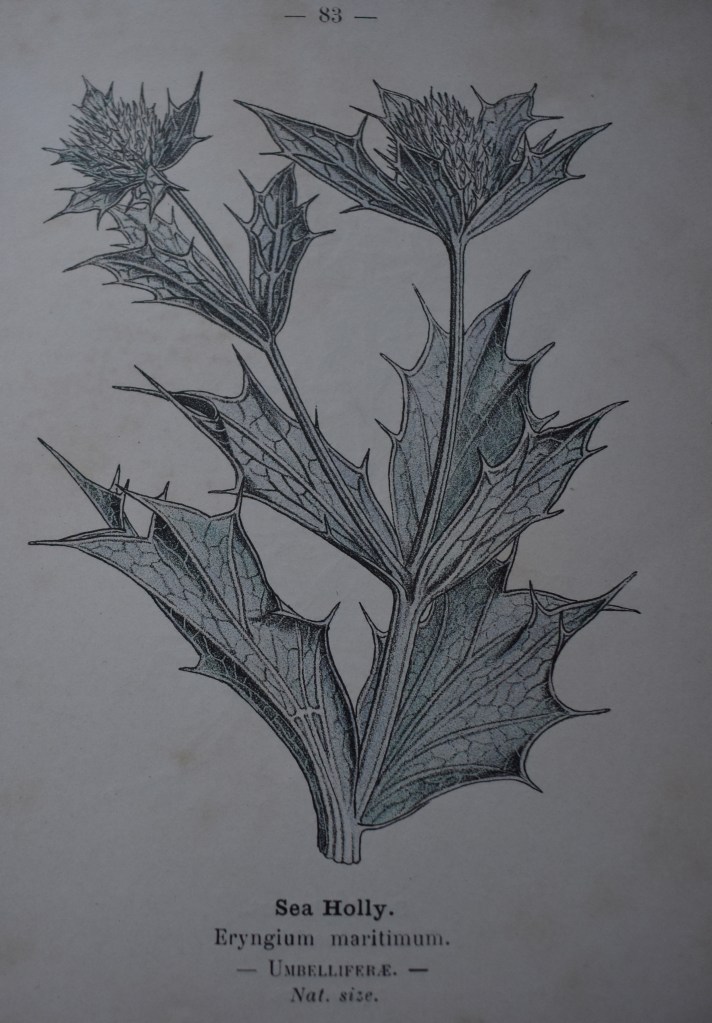
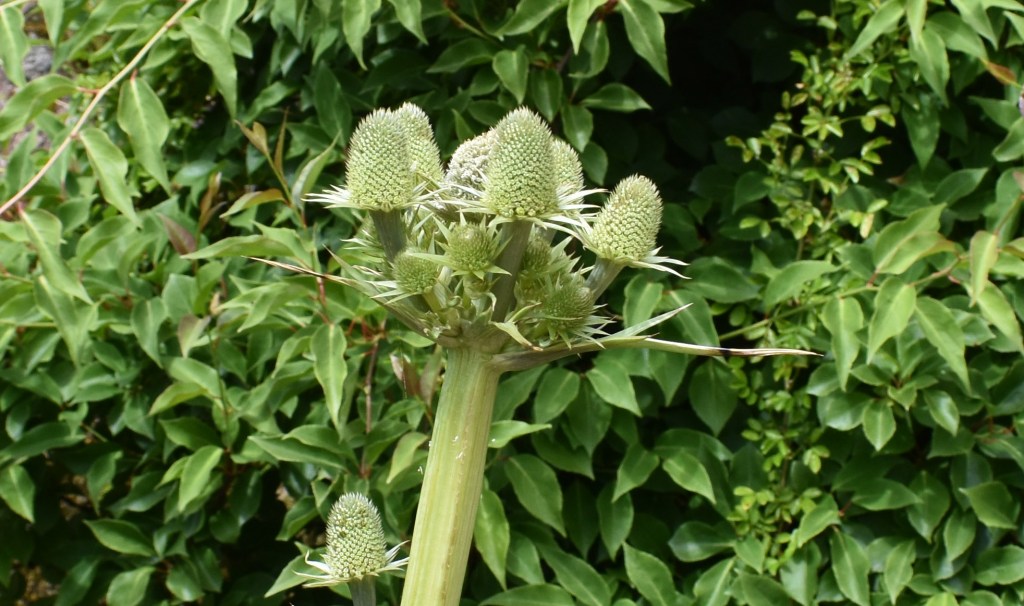
All through spring and summer I have been watching the eryngiums. There are quite a few different species growing at Crathes and although few of them are labelled I am making headway with some of the names. Stace (New Flora of the British Isles) names four different species, two of which are likely to be native, although one (E. campestre) is confined to south-west Britain. The native I am familiar with from my childhood holidays is Eryngium maritimum, the sea holly, which grew in the sand dunes in North Wales and, I think, Cumbria. Once common throughout Britain, it is now mostly gone from Scotland and the north of England. Thinking to find an illustration of the sea holly, I take down my Familiar Wild Flowers by F Edward Hulme which has no copyright issues. This book, in 7 volumes, was a childhood companion. It is where my mother and I learnt our wild flowers. I am sure the eryngium will be there, but volume 3 is missing and, typically, the sea holly is not to be found. I find an illustration in my 2 volume Wayside and Woodland Flowers by Edward Step – books I acquired in later life. From the 1960s my ‘go to’ book for wild flowers has been W Keble Martin’s The Concise British Flora in Colour. This book, a lifetime’s work, was published in 1965 and at the age of 89 Keble Martin became the best-selling author of the year.
The book I have found most useful for identifying eryngiums is volume 2 of Perennials by Roger Phillips and Martyn Rix (1991). There are lots of illustrations as well as much helpful information. An RHS plant guide on Perennials is similarly useful.
There is a lovely group of eryngiums growing in the Upper Pool Garden.
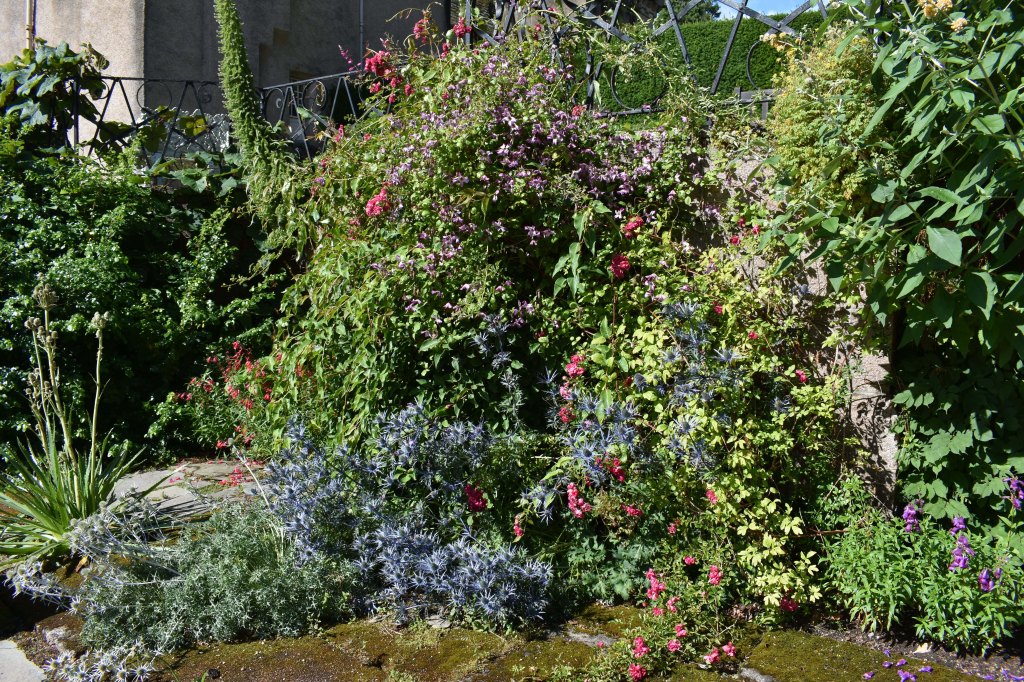
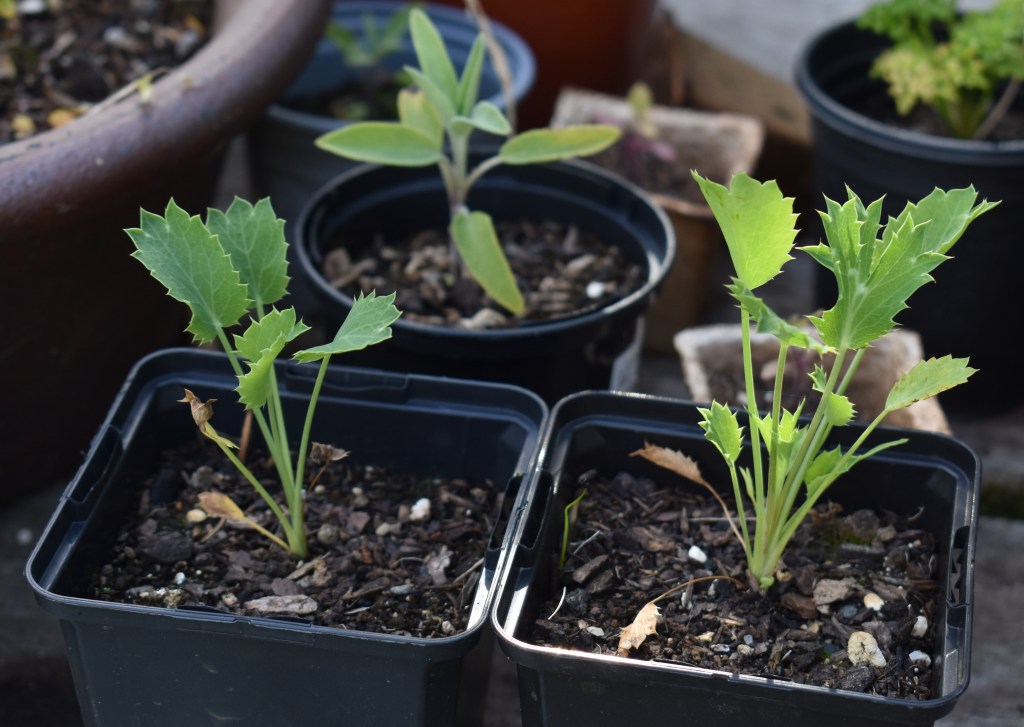
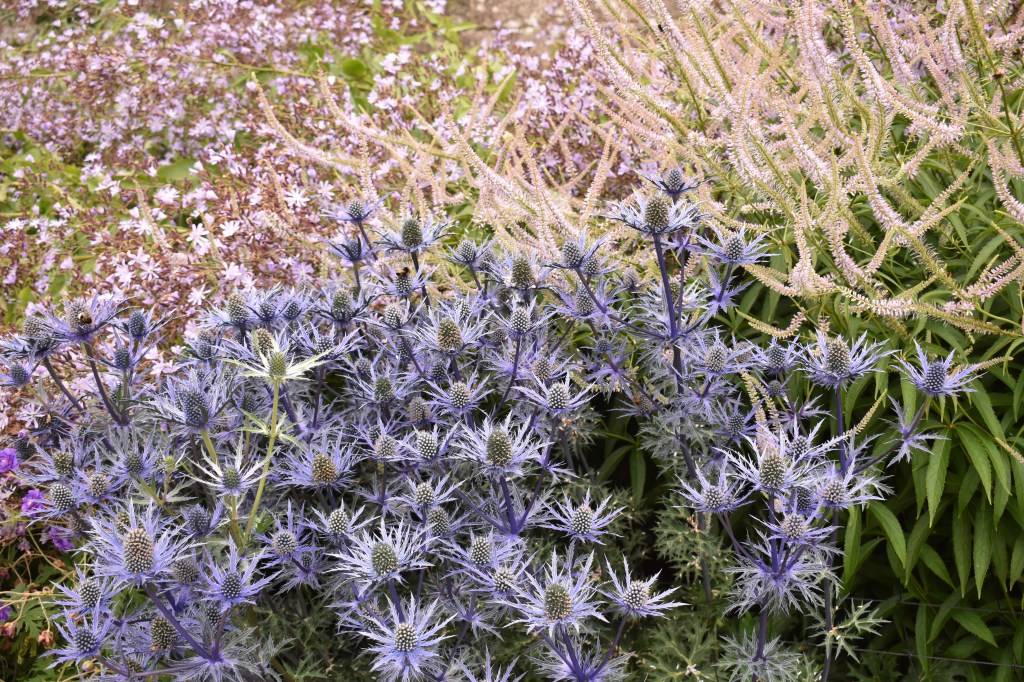
One has particularly attractive foliage and looks good at any time. It is probably Eryngium bourgatii from the Pyrennees. Much taken by the foliage I determined to grow it in my garden. Instructions on the seed packet said to sow in container in plastic bag and place in fridge for three weeks. This I did in early March. I then put the container outside in the shade and promptly forgot about it. Months later I found that two seeds had germinated. These seedlings are now planted out and I wait to see if they will survive the winter – and if they become the plant that I expect. Such is the excitement of growing things. I do have Eryngium planum in my garden but I bought it fully grown. The blue/purple colour of the stems is intense. The bumble bees, however, seem to prefer the lavender and nasturtiums. I noted that a lot of E. planum grows in the newly planted Aberdeen Union Terrace Gardens.
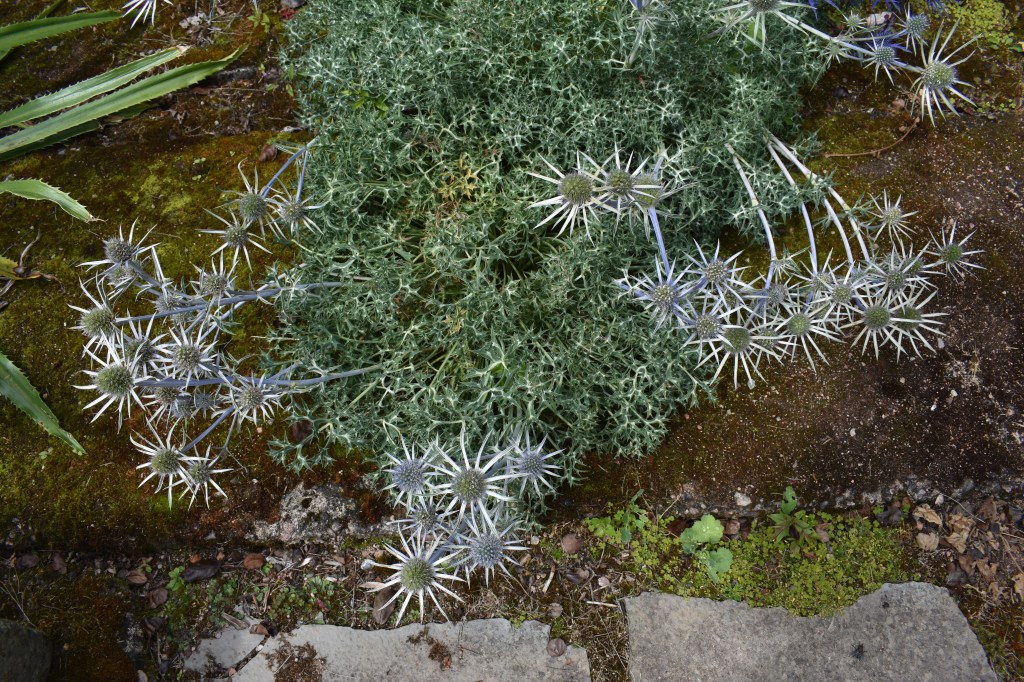
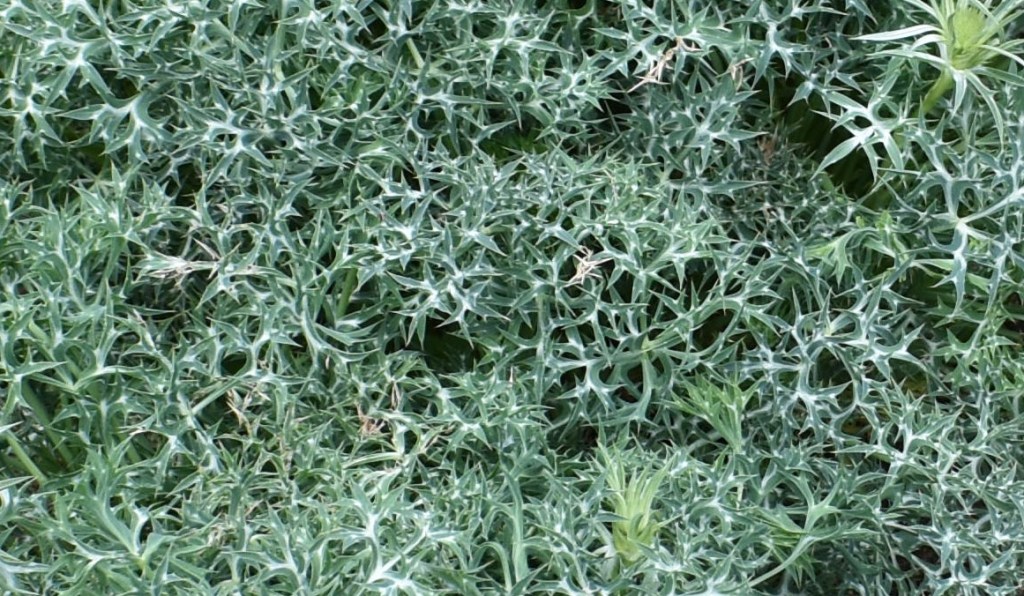
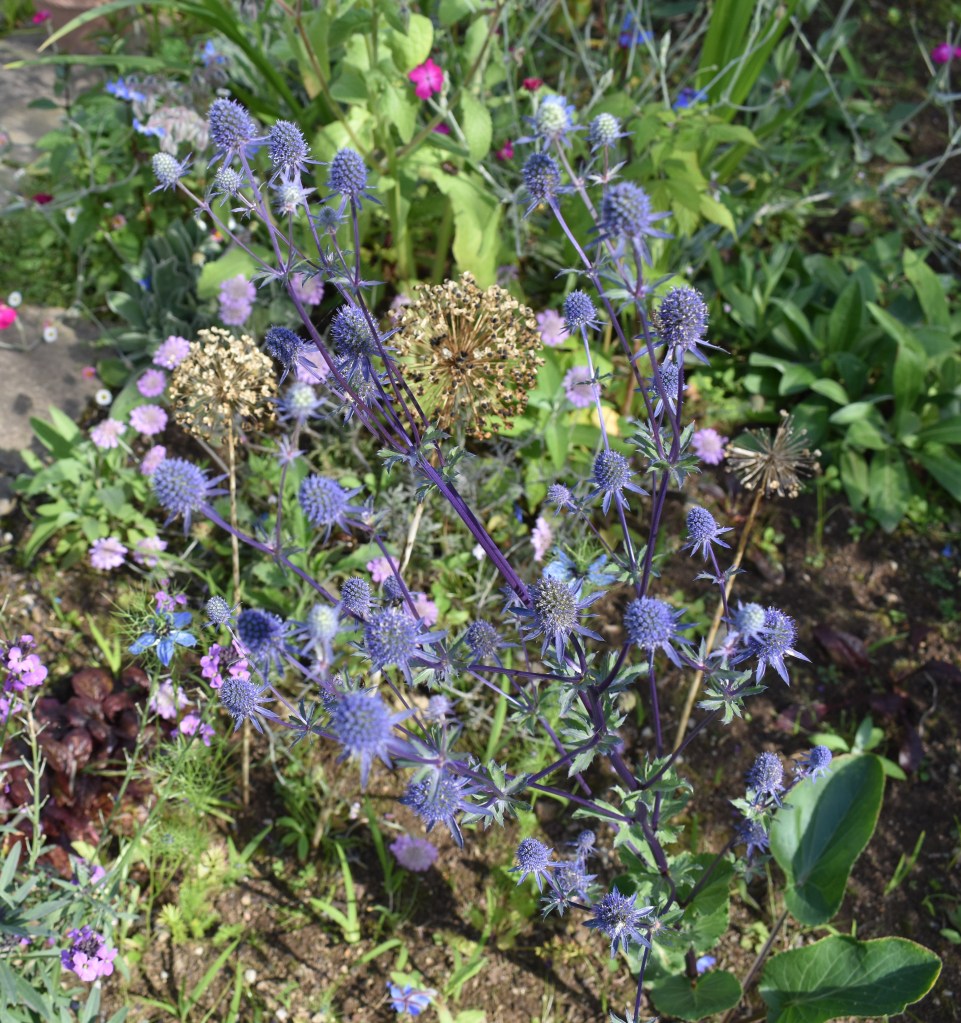
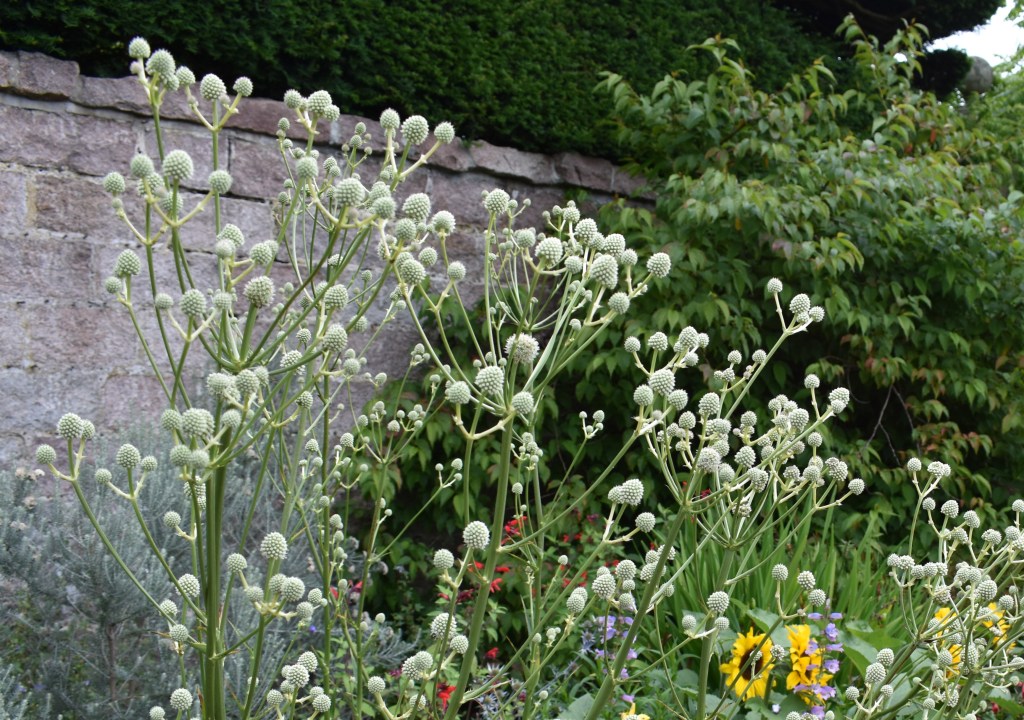
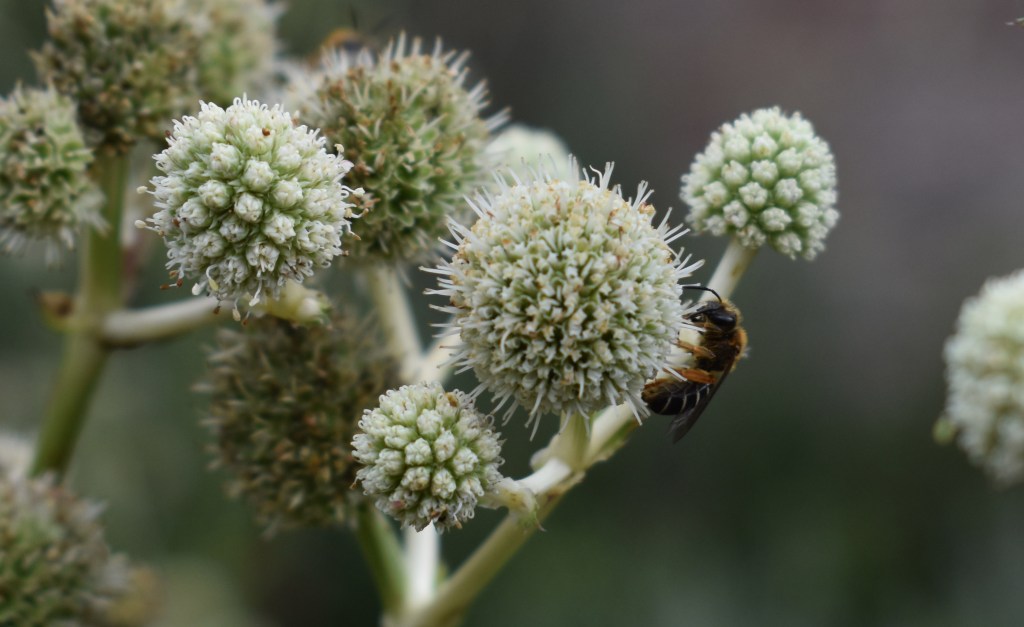
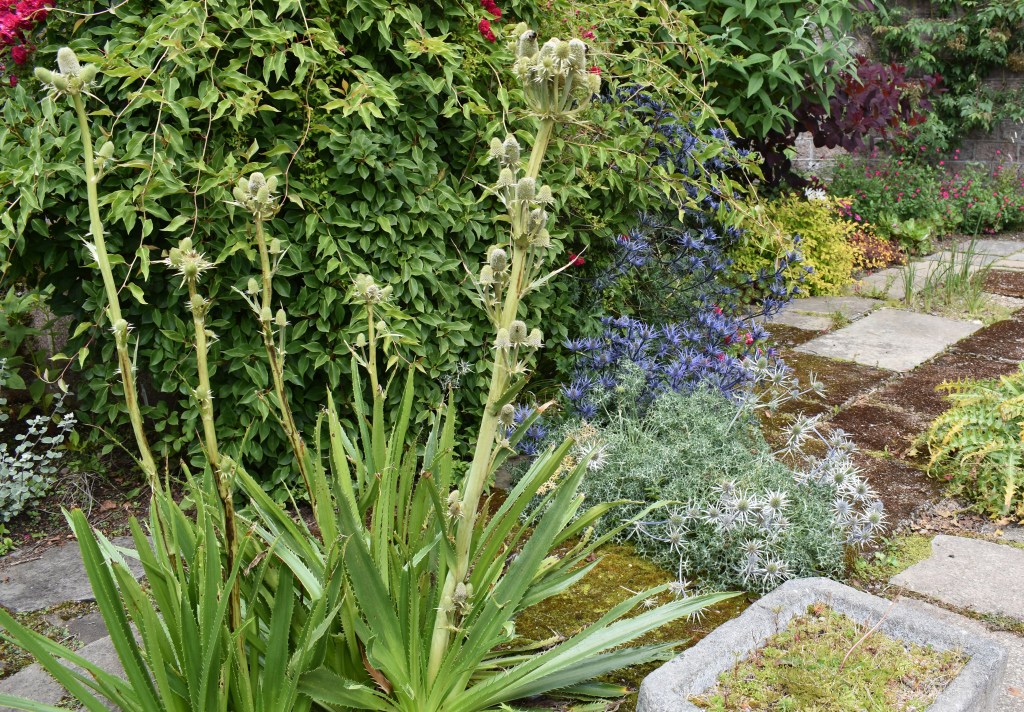
Back at Crathes I follow the fortunes of the various species and realise how well they last; flowering from about June and still looking good in September. Furthermore they are excellent for flower arrangements either fresh or dried. Some are especially attractive to insects – E. eburneum may lack the stunning blue but that doesn’t deter the insects. E. eburneum and E. agavifolium are both from South America and are said to prefer a damper environment, whereas the others that grow at Crathes are from Europe and need a well-drained soil. There is a very fine eryngium on the Blue and Pink Border which is thought to be E. alpinum ‘Superbum’.
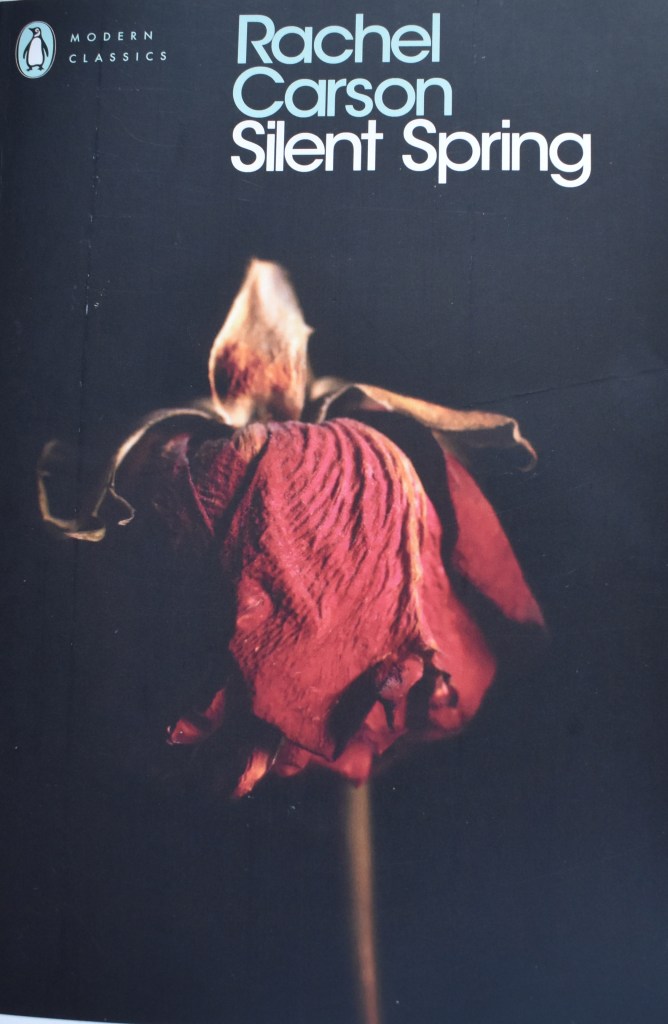
I am reading Rachel Carson’s Silent Spring; a book that changed the world and inspired the environmental movement. I am ashamed to say it passed me by in the 1960s. It was published in America in 1962. Carson was vilified by the press and the agri-chemical industry for poor science and because she was a woman. A former US Secretary of Agriculture was known to wonder publicly ‘why a spinster with no children was so interested in genetics’. But her science was rigorous and she communicated well with her readers. Despite the abuse the book became a best seller and, most importantly, American policies were changed. Tragically Carson died less than two years after the book was published.
Although Silent Spring passed me by, I was well aware of the danger of pesticides because in Britain the focus in the 1960s had been on raptor research. Organochlorine pesticides had been in use through the fifties and ornithologists were working on sparrow hawk and peregrine decline. Derek Ratcliffe was leading the research which connected pesticides with thinning eggshells leading to poor breeding success.* A voluntary ban on organochlorines was achieved in 1962 but it took another 20 years before the ban was enforced. Today peregrine and sparrow hawk numbers are much healthier, but habitat loss is a real threat.
60 years on it would be good to think that governments have learnt important lessons regarding pesticides, but sadly we are still battling – this time against neonicotinoids and their effect on bees.
Incidentally, Derek Ratcliffe was also important in achieving the removal of tax breaks for the planting of non-native conifers in peatland – especially in the Flow Country, to the north of Inverness, in Caithness and Sutherland. This is particularly pertinent just now as, following restoration work on the blanket bogs of the area, the Flow Country is being assessed for inclusion in the UNESCO World Heritage Site list. It is important for its biodiversity and as a carbon sink.
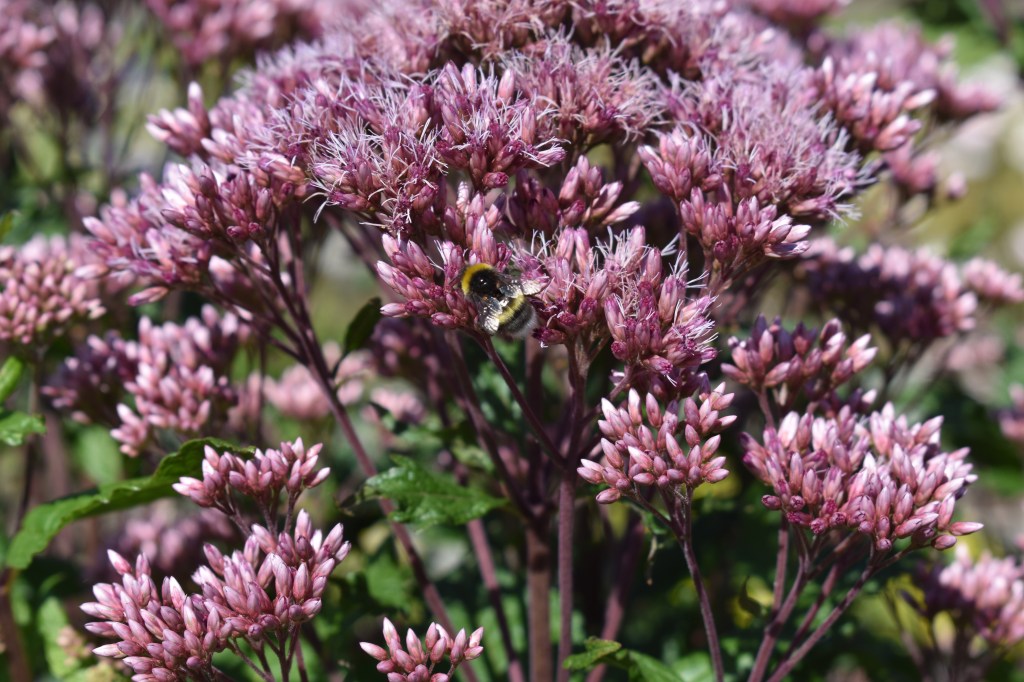
All this may seem to be rather far removed from Crathes, but these connections are of vital importance to a planet increasingly under stress. As I watch the bumblebees pollinating my single runner bean plant and see the young beans developing I reflect on the insect buzz in the Crathes Rose Garden where plants such as hemp agrimony, catmint, sedums and lavender are planted in pesticide-free profusion; I rejoice at reports of the growth of the young pines at Mar Lodge estate helping to cool the streams for young salmon and I think of the Crathes Millpond project which, in partnership with The River Dee Trust and other stakeholders, is also helping to improve the environment for young salmon and other fresh water flora and fauna. Across the world people are making a difference, but the need for these connections is urgent.
We and all the organisms in this world are connected in some way; every one of us can help with the healing. It’s our choice.
Updates:
All the hedges have been cut. There have been some weary gardeners who are glad to see that job completed for another year.

Joanna has been busy taking cuttings and collecting seeds for next year. She and James spent time working round the garden planning next year’s planting with glasshouse capacity in mind.
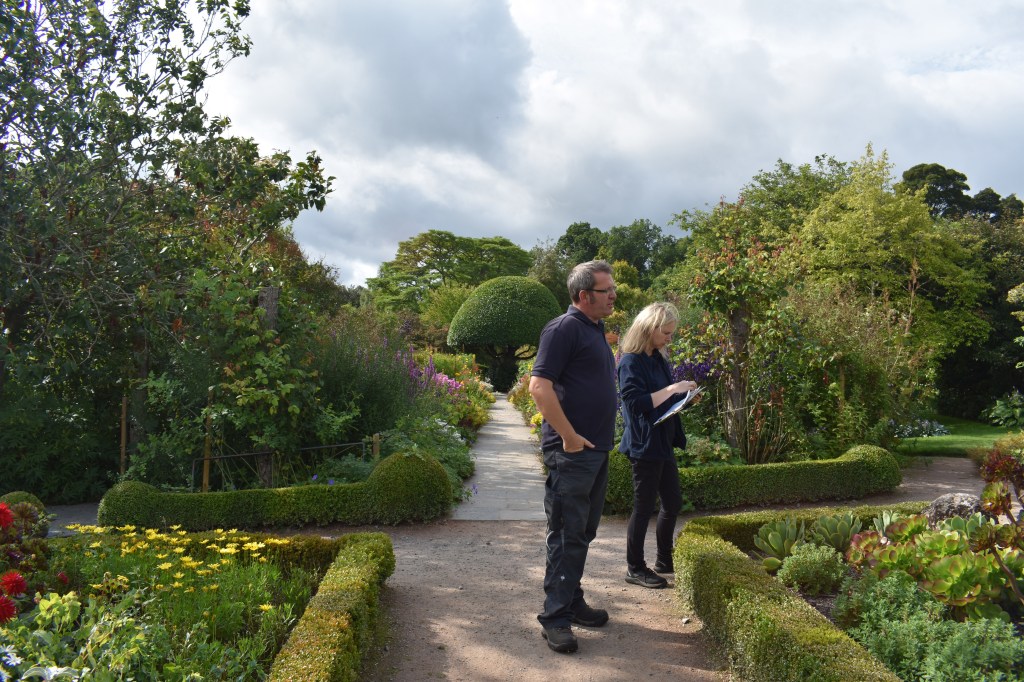
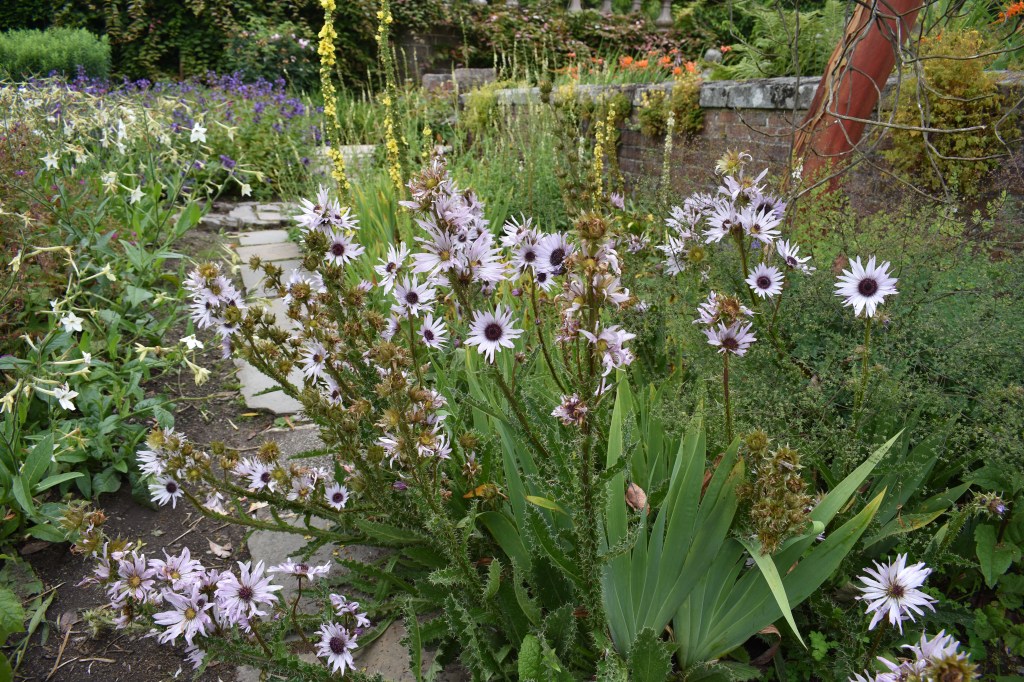
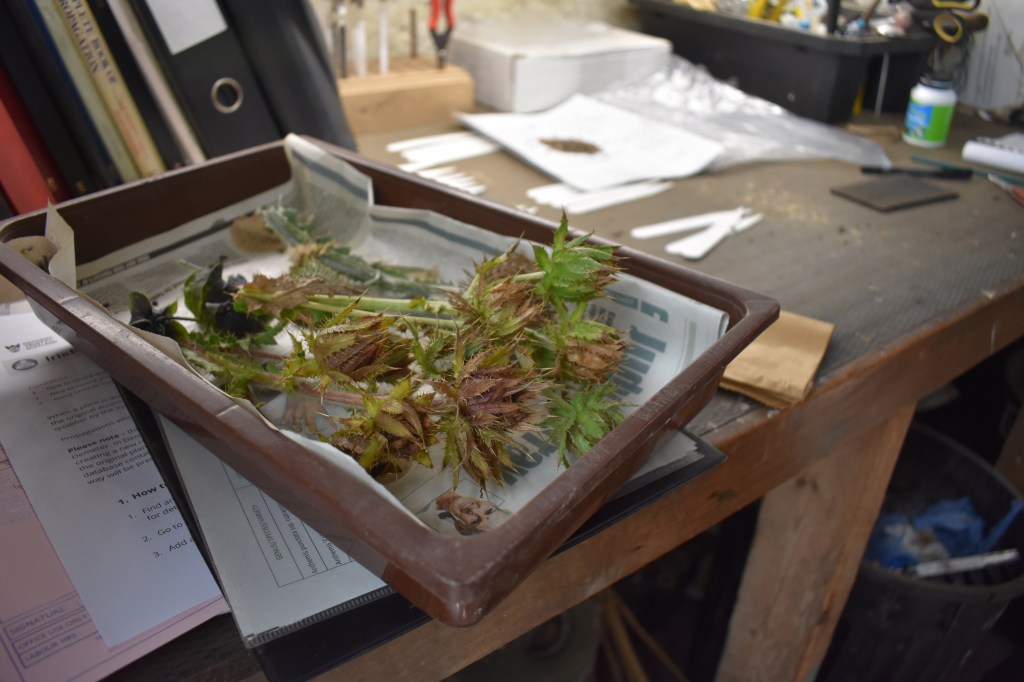
The regular garden volunteers have been working away at the never-ending weeds.
The drinking water in the bothy is now flowing from the tap. The flavour is devoid of chemicals – maybe the ‘elixir of life!’.
By mid-September we have butterflies; especially red admirals.
The oyster catchers sat for weeks on their eggs with no outcome.
(Computer problems have dogged me all summer, slowing everything down. A new computer should make all the difference.)
*The Peregrine Falcon by Derek Ratcliffe was first published in 1980. It includes a history of the 1960s research.
 Notes from Crathes
Thank you again for another stimulating article! The solitary eryngium in our border is very popular with our bees – we had 3 separate tree bee colonies this year, as well as the bumble bees! Brian has managed to grow some eryngium plantlets from its seeds this year without freezing. We will have to see if they survive the winter in the greenhouse!
Like you, I had no time to read ‘Silent Spring ‘ when it was first published, but it now has pride of place in the bookshelf. No pesticides ever in our garden, and I am gradually wearing down my old-fashioned neighbour who is beginning to appreciate our full of life ‘rustic’ garden!
Fingers crossed that the Flow Country gains its rightful place on the World Heritage list – it is an amazing place!
Oystercatchers in the nearby field have been driven out by dog-walkers whose choices are becoming more limited….
I hope your computor problems are soon resolved! Thank you again for sharing all this heartening information – nature is fascinating!
LikeLiked by 1 person
Good stuff Jenny. To borrow a phrase – every little helps!
LikeLike
So lovely to see you both today. With a few exceptions I shall be volunteering
LikeLiked by 1 person