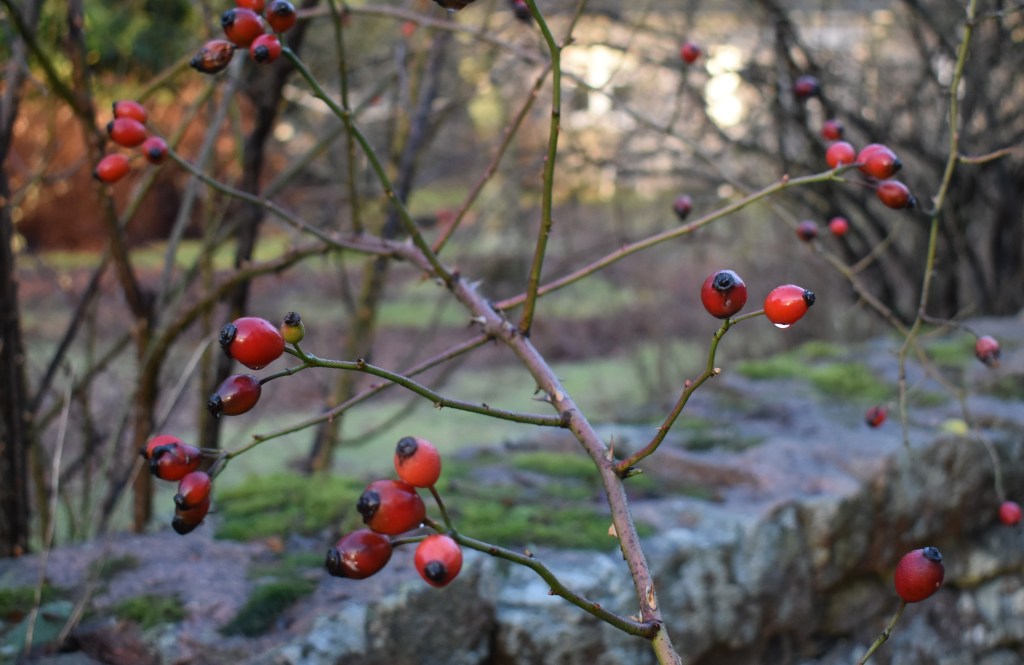
Yet more rain has fallen. When I visited Crathes mid-December I found the rangers working hard on the Millpond sluice. There had been heavy rain overnight and the sluices had to be opened to avoid overflow of the pond. But now that the rain had stopped, the sluice had to be adjusted to keep the water level in the pond high enough to enable any fish using the ladder to access the pond.
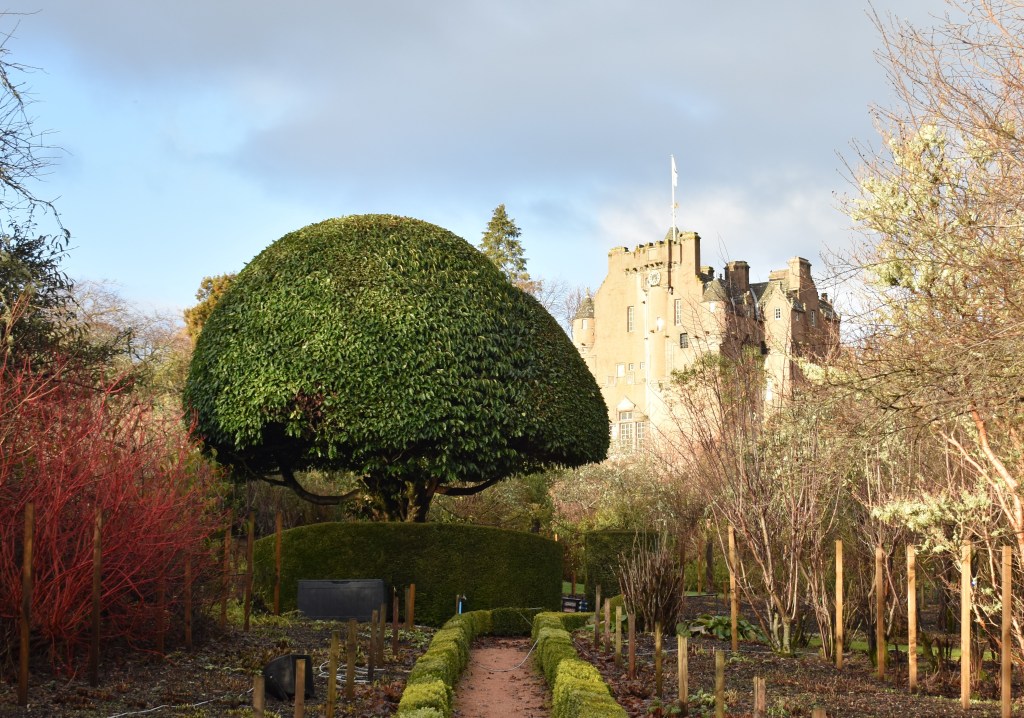
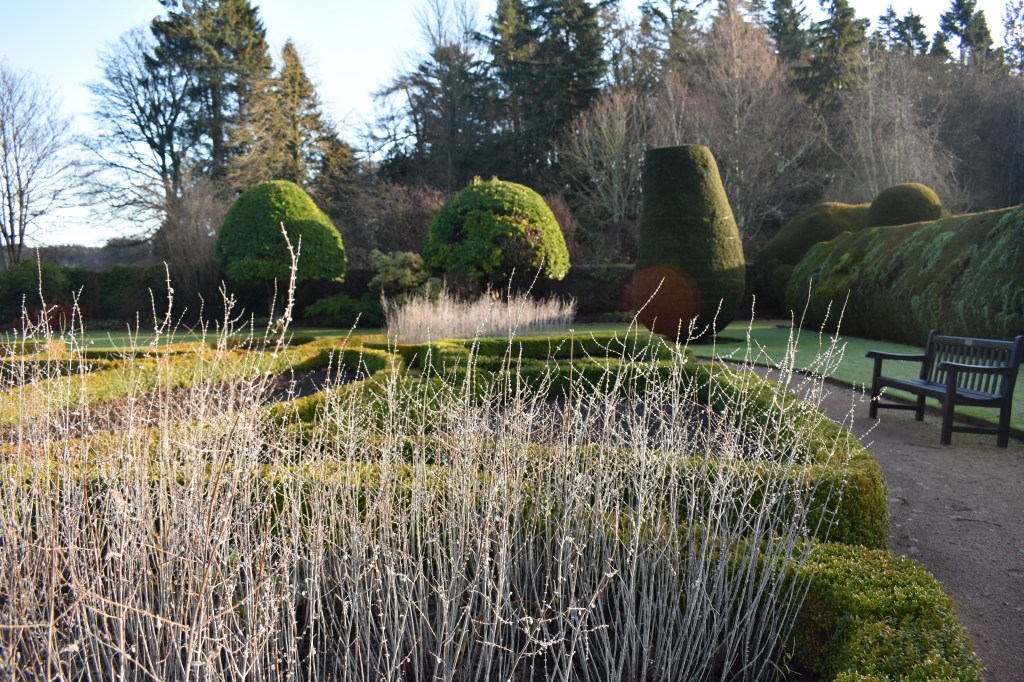
It was, for a change, a lovely day. In the garden people were setting up a light show as part of the Christmas events. But I had my own light show as the December sun slanted low across the garden picking out different highlights.

One of the winter jobs at Crathes is the spreading of compost. There are three big compost bays in the yard: one full of recently added unrotted greenery and brown vegetative waste, one still working and one full of lovely crumbly sweet smelling ‘oven ready’ compost.

Compost is at the heart of a good garden. People sometimes ask how the Crathes plants can grow so big and my reply is always ‘the compost’. There is not enough compost to cover all the beds in the (nearly) four-acre walled garden each year which means a rotation is observed. Last year the June, the Blue and Pink and the Double Herbaceous borders were priority. The leaf mould that is gathered beside the emergency drive is also important. This is nature’s compost and it has been especially valued at Crathes as a replacement for peat which has not been used in the garden or glasshouses for more than twenty years. The many beech and oak leaves that are shed from trees that grow around the area break down rapidly producing a brilliant friable soil improver; sycamore and chestnut have tougher leaves and take longer to decompose. The leaves gathered up from the garden are generally added to the compost. There is no need to dig in the compost after it is spread. Initially it will act as a mulch, controlling weeds and preventing drying out – although drying out is not really a problem in the winter, and definitely not this year. This is where the worms come in, pulling down the organic matter in the compost and leaf mould, eating it, and pooing. Worm poo is highly nutritious for plants and the organic matter that is not eaten encourages a biodiverse community of microbes, bacteria, fungi and other organisms. The more organisms in the soil; the more water and carbon is held by the soil. High water and carbon content indicates a healthy soil. Last month I was writing about the peatlands of Scotland acting as a sponge and sequestering carbon and it turns out that soil – healthy soil – is equally important. A quick look at reliable sites on the internet will tell us that a teaspoon of soil holds more microorganisms than there are people on the earth. Because soil is just about everywhere the biomass of healthy soil and its potential for carbon sequestration is globally considered to be greater than all the carbon sequestered by all the forests of the planet. The roots of grasses and herbaceous plants that store carbon are not so vulnerable to fire as forests; undisturbed grasslands have particularly high carbon content.
As I am writing about soil I discover that 5 December is the United Nations World Soil Day. I quote from the website: Sustainable soil management practices, such as minimum tillage, crop rotation, organic matter addition, and cover cropping, improve soil health, reduce erosion and pollution, and enhance water infiltration and storage. These practices also preserve soil biodiversity, improve fertility, and contribute to carbon sequestration, playing a crucial role in the fight against climate change.
Whilst Crathes is no longer in the business of food production, the gardeners want to grow healthy plants and support the planet; the recent reduction in pesticide and herbicide use will do both. If you see a few weeds on the paths remember that hoeing is more time consuming than spraying, but also more planet friendly.
I, however, do not have a healthy soil. I have a major problem in my garden: there are no earthworms. We have been here eighteen months and not one worm has been seen. The compost heap tells the same story; usually when a new heap is started the brandling worms (a type of earthworm particularly attracted to rotting vegetation) just appear, but not so here. As a result, the heap didn’t really work even with activator from the garden centre. I looked into buying worms. A large UK business supplies worms, but they come from Canada (albeit with DEFRA’s approval). Such a purchase was not for me. A local firm advertised that they could provide compost worms, but nothing came of my enquiries. Last month I visited family in East Lothian and returned with a precious box of compost worms. Success I hope – though it was a frosty night when they were installed in our heap. I will have to be patient and wait for some warmth before I can expect a satisfactory outcome. The problem of the earthworms, however, is not yet resolved. If I do have a good compost to spread, how will it be drawn down into the soil? Earthworms seem to be as important as bees and I hear on the BBC News that earthworms are in decline. Without these burrowers soils are degraded. I ask James if he thinks my problem is the New Zealand flatworm (an invasive species that eats earthworms). Possibly, he thinks, but it’s more likely that the topsoil of the small housing scheme (now 26 years old) was scraped off and replaced with subsoils. For the time being I have bought some organic mulch that I am using on the raised bed and round the fruits trees I planted.
Whilst a large amount of organisms in the soil is usually good news, there are some occasions when they are not welcome. The new steriliser is used on the loam which is added to glasshouse compost (it’s aggravating that the term ‘compost’ can be used to denote both rotted vegetation and potting mixtures) to ensure against damping off which is caused by fungal pathogens that attack in cool damp conditions and can kill whole trays of newly germinated seeds. You can see more detailed recipes on how Joanna makes up the different composts in the post ‘Hope springs eternal’ 13 October 2021.
One day, looking in the bookshop for Christmas presents I am attracted to The Age of Resilience with the subtitle Reimagining Existence on a Rewilding Earth. The author, Jeremy Rifkin, is an American economist. Maybe my son would like this book. At home I begin to read. In the introduction I learn the term ‘net primary production’ referring to the energy available to the earth from the sun by the process of photosynthesis – the source of all our success. The initial chapters are about efficiency, economists such as Adam Smith, and scientists such as Einstein and Newton. Then suddenly I find soil is centre stage: But net primary production is not possible without nature’s base capital, soil. The efficiency that became the god of nineteenth and twentieth century economics is suddenly exposed as a short-term solution that is no use without resilience. The ‘green revolution’ so popular in the 1960s depended on high yield seeds, pesticides, irrigation, and whilst initially fruitful began to be seen as a false economy by the 1980s. The years of industrialised farming had degraded the soil by enabling two crops a year, leading to soil run off and decreasing yields. In Moray, where I used to live, we would watch the topsoil blow off the fields each spring, sometimes blocking the roads with the sandy soil. However, I don’t manage to finish reading the book because I need to post it in time for Christmas – another copy has been ordered!

Thinking of the turning of the year reminds me that some archaeologists think that the world’s first (as yet) lunar calendar is located in the Warren Field at Crathes. A series of twelve pits, thought to be post holes, found in 2004, are considered to represent the changing cycles of the moon and align on a distance gap in the hills. This would show a sophisticated understanding of their relationship with the natural world by the Mesolithic peoples of Deeside. Our light polluted environment has deprived us of a proper awareness of the night sky; the landscape of that time would have been very different from that of today. The same field is also the site of one of the earliest Neolithic large buildings with more postholes suggesting a large communal hall or house made from oak trees. There is nothing to see in the Warren Field today, but no ploughing is allowed on the site in order that the archaeology can be preserved. We can only wonder about these people and their lives. In these early times it would be dark by about four o’clock at this time of year and only fire could keep the dark at bay. There is much to wonder at in the world. It would be good to take time to wonder anew in the New Year.
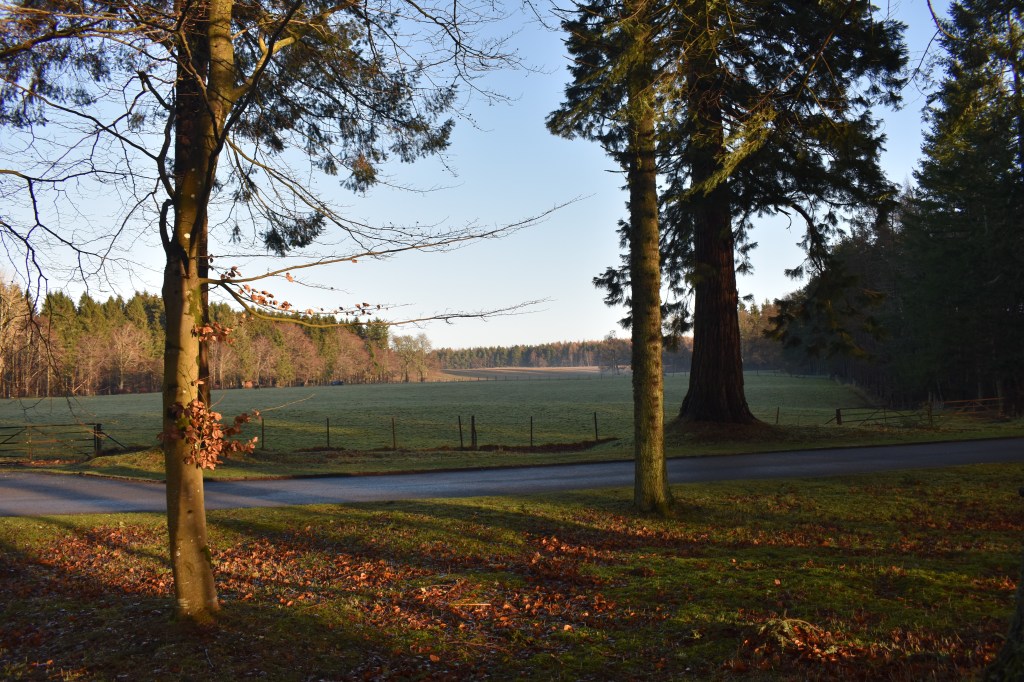
Updates:
Beavers are to be returned to the Cairngorms. One pair has already been released on the Rothiemurchus Estate near Aviemore and another pair nearby. Over the next five years fifteen more families could be released in the Spey catchment area.
The rangers report that the squirrel trail is now fully opened. It has been partly closed since Storm Arwen, two years ago. Of course, you might see red squirrels on any of the trails at Crathes.
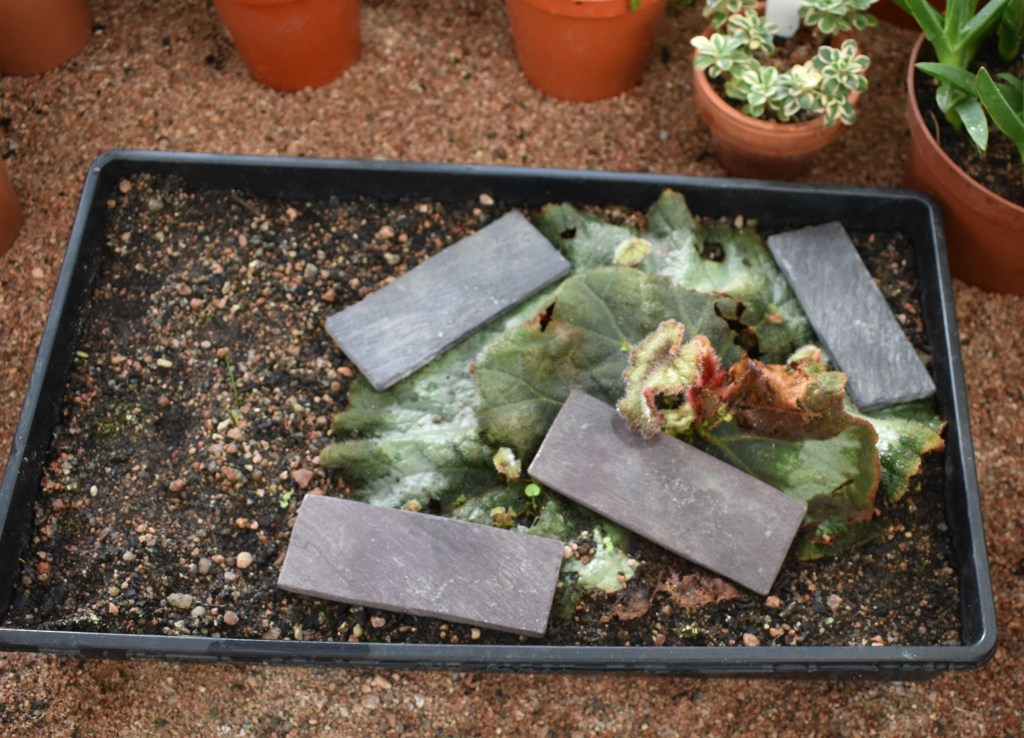
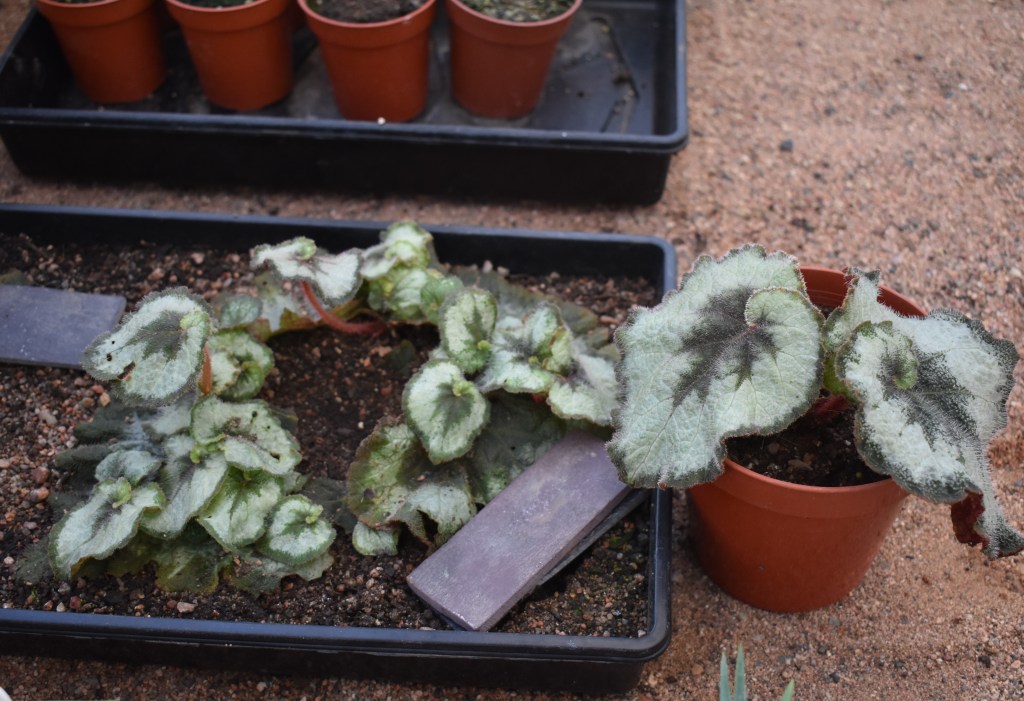
The begonia leaf cuttings are developing well.
Glass house 1 is being cleaned and repainted with longer lasting mineral paint.

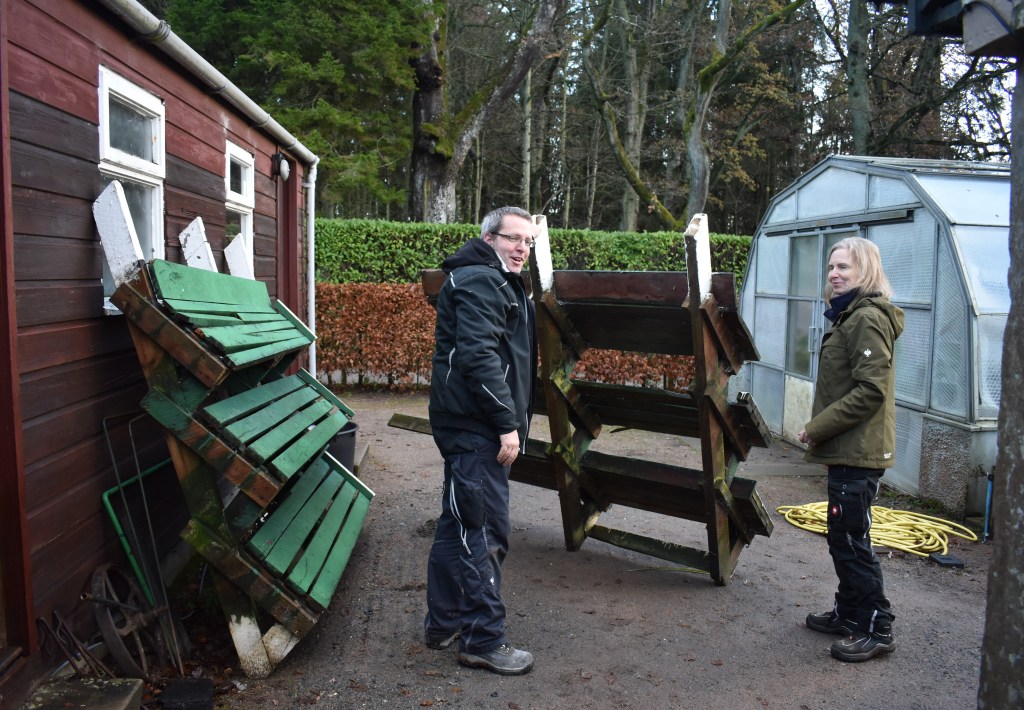
A photo of three of our Crathes volunteers has been used as a Christmas card to send to all NTS staff and volunteers.

Happy Christmas everyone and peace in 2024.

 Notes from Crathes
A very enjoyable read – as always, a pleasure to receive these beautiful and informative posts. Have a great Christmas and New Year – I do hope those worms make it through the winter and are helping hands in your garden next year and beyond.
LikeLiked by 1 person
Thanks Sandra. Yes I certainly need those worms to do their stuff. Have a good festive season and maybe see you next year!
LikeLike