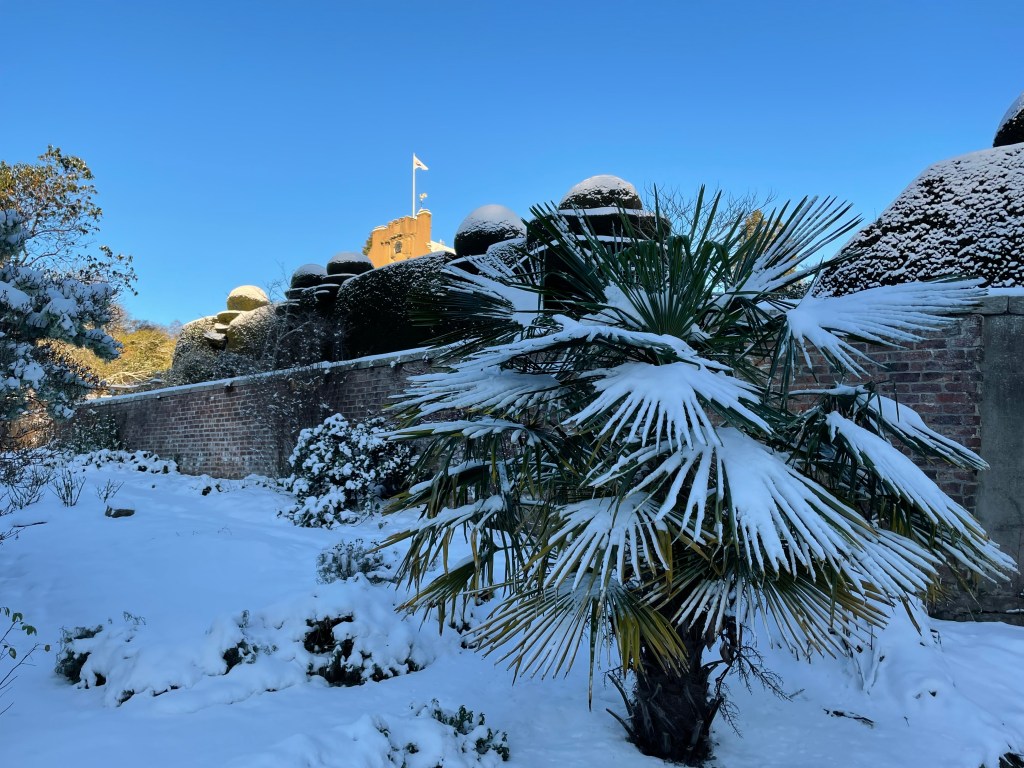
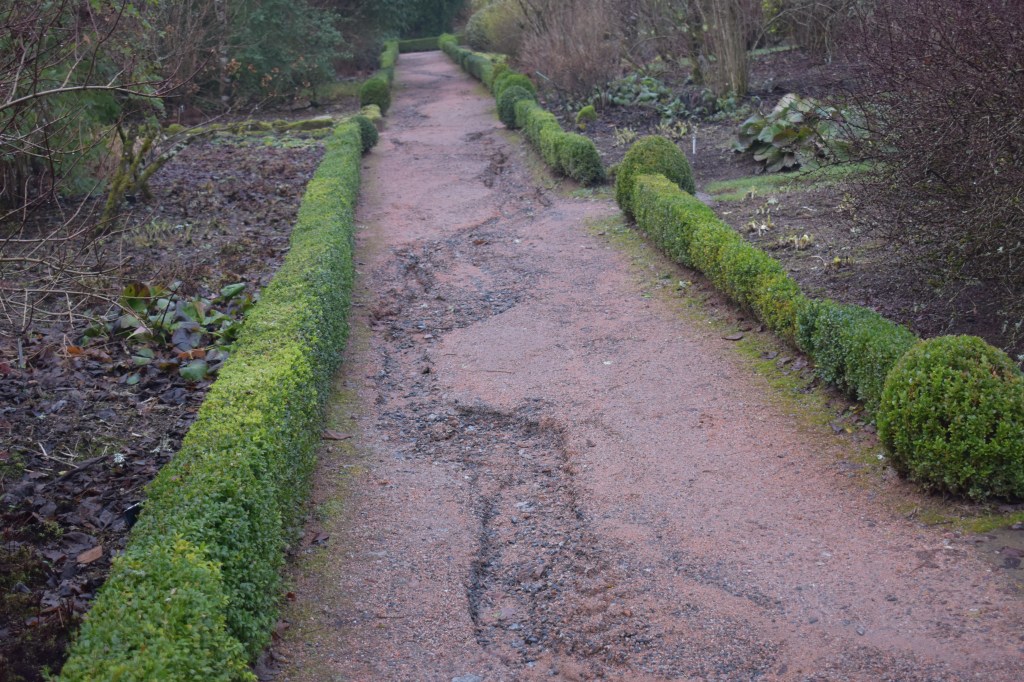
The rain continued over the festive season. Storm Gerrit hit on the 27 December flooding and closing local roads and threatening to overflow the Millpond once again. A blocked drain in the Woodland Garden caused water to back up and run through the entrance building from where, at the storm’s height, it followed two routes – some pouring down the White Border and washing away parts of the June Border path; some following the Berberis Border and then washing away parts of the South Border path. Storm Henk followed four days later but was at its worst in England where many homes were flooded.

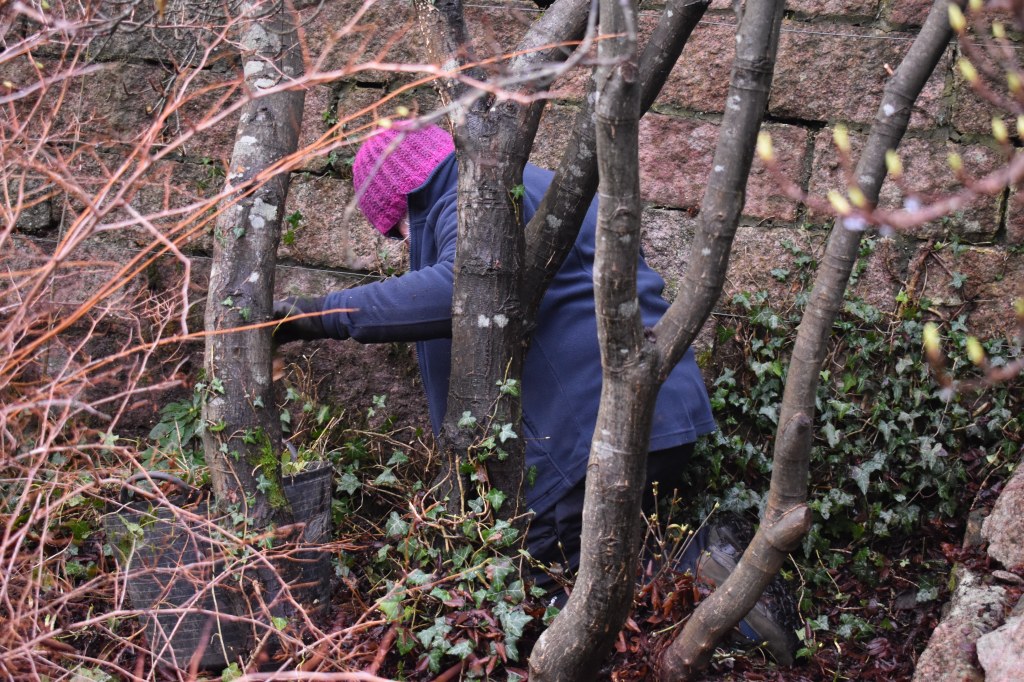
After perusing the weather forecast I chose to visit Crathes on 12 January when bright sunshine was predicted for most of the day. The reality turned out to be a freezing fog that penetrated the bones. Removing ivy from the yew border wall is imperative because it is beginning to penetrate the stonework, but it’s not much fun on a cold damp day. All the gardeners were troubled with cold hands and glad to gather in the bothy at lunchtime. As we moaned about the incessant rain, Cecilia said ‘I just can’t wait for the drought’. We were all in accord thinking with nostalgia about those hot dry days of last year. Globally 2023 has been the hottest year on record. Not something to celebrate; it’s just that the relentless rain is so depressing.

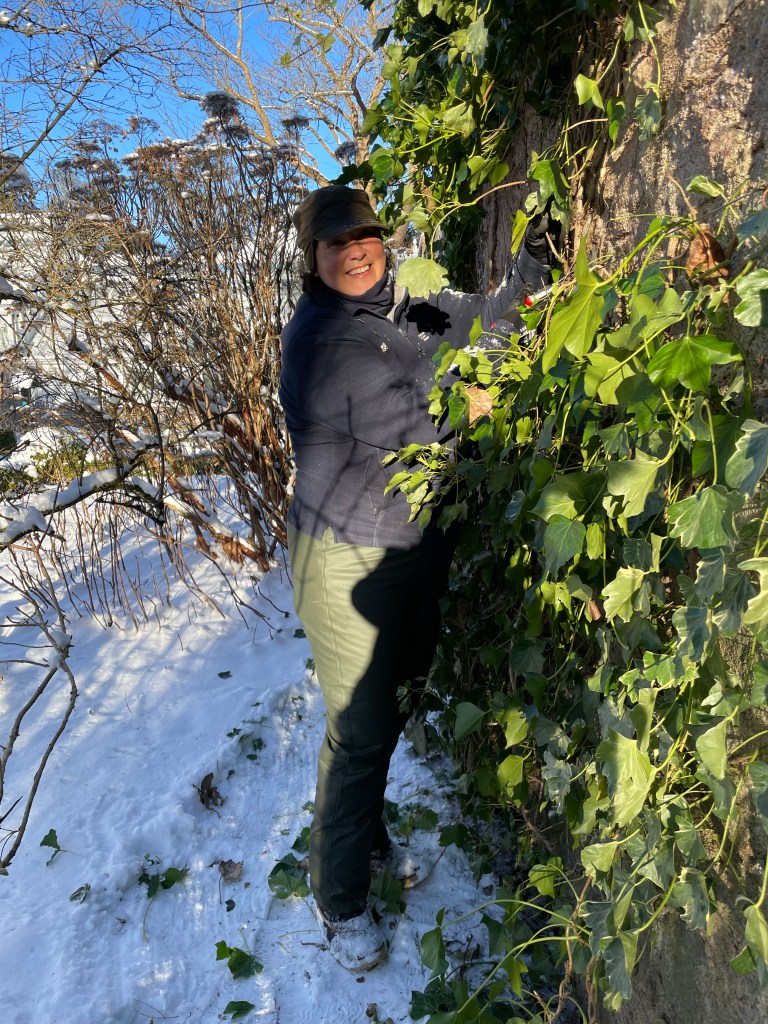
By the next week the rain had become snow which brought more problems for gardeners getting to work. The snow and ice kept me away but Joanna sent me some lovely photos enhanced by the early morning sun and the blue skies. Even removing ivy became a pleasurable job in the sunshine.
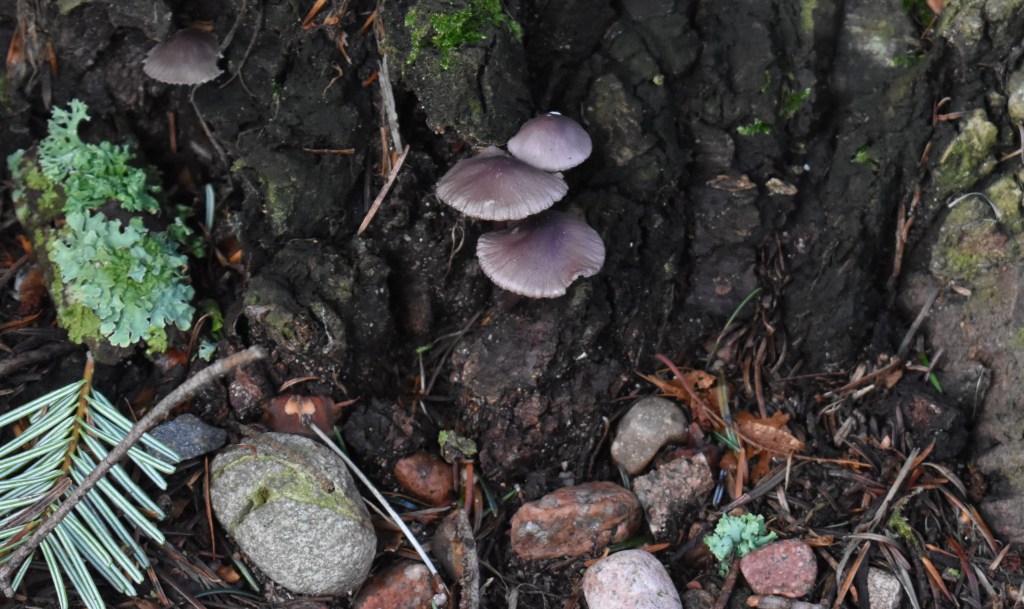
One of my Christmas books has left me contemplating the transitory nature of our existence as a species. Last month I briefly considered the Neolithic peoples of the Dee valley. Otherlands by Thomas Halliday takes us back to ecosystems from before the evolution of Homo sapiens.* These ecosystems, surmised from the fossil record from various parts of the world, are all relevant to our modern world in some way and often they refer to plants that are grown at Crathes. Sometimes the ecosystems described are found in the North-East of Scotland. Rhynie, not much over twenty miles from Crathes as the crow flies, has fossil records of one of the earliest known land-based ecosystems. The Rhynie chert was formed when hot spring water cooled rapidly and precipitated a supersaturated silicon over the fungi, bacteria, plants and invertebrates that co-existed in this area. At this period of the Devonian, 407 million years ago, Rhynie and the rest of Scotland was sitting just below the equator and was more aligned to North America than England. The detail of preservation at Rhynie is so remarkable that individual lichens, fungi, early spore-producing plants and arthropods such as harvest spiders can be clearly seen and scientifically named – forty different species of plant have been identified and a whole range of major modern groups of fungi have been differentiated in ancestral form in the chert. The fungi appear to be forming relationships in lichens and with the early plants in the form of mycorrhizae. ‘That they [mycorrhizae] are present so early in the evolutionary history of plants suggests that this relationship is not just ecologically important but fundamental to the development of life on land.’ The organism relationships that we know are so important to healthy soil today seem to be the building blocks of all terrestrial ecosystems.
Still in the Devonian period, but 35 million years on from the Rhynie chert date, there is evidence that the first four-limbed vertebrate emerged from the water at Scaat Craig – a fossil site a few miles to the south of Elgin. Early land colonisation is on record in the North-East of Scotland!
An ecosystem that we may be more familiar with is that of the Cretaceous era (145.5 million years ago – 65.5 million years ago) when dinosaurs roamed the earth. The Natural History Museum website tells us that dinosaurs such as triceratops, tyrannosaurus and velociraptor, and many bird-like species were evident in Cretaceous times. The landscape is thought to have been open coniferous woodland with fern and cycad-type undergrowth and maybe rivers and wetlands. This ecosystem was destroyed when a large asteroid (ten to fifteen kilometres wide) hit the earth off the coast of Mexico. The ‘impact winter’ that followed over the whole planet lasted for ten to fifteen years and 65% of all species are estimated to have been wiped out in the great Cretaceous extinction. A few primitive mammals survived, but the only dinosaurs to survive were those that later evolved into our modern birds.
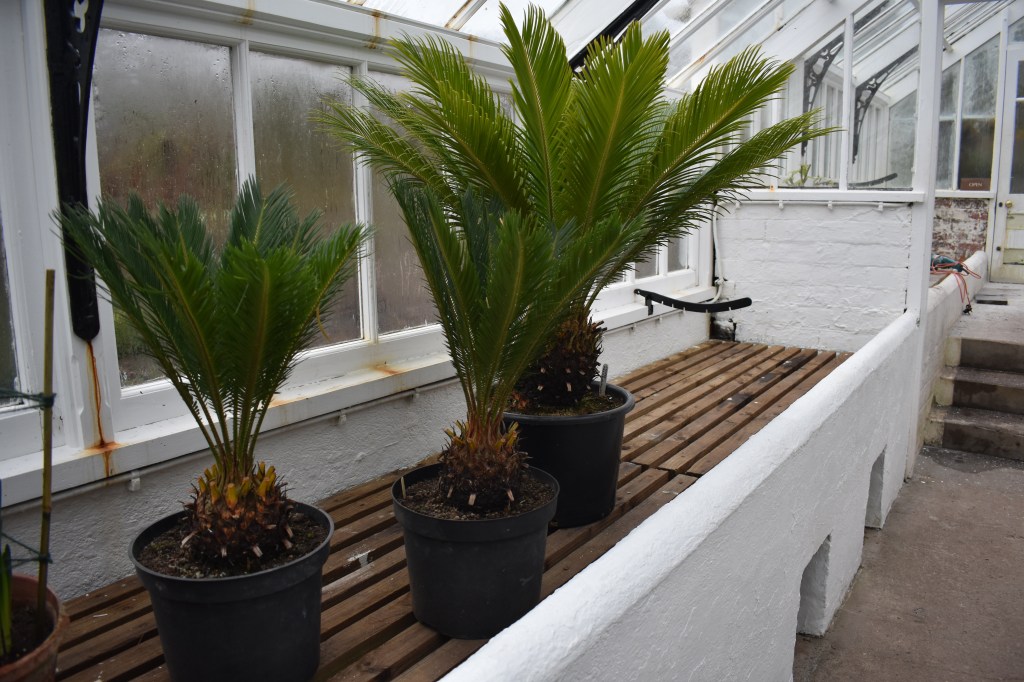
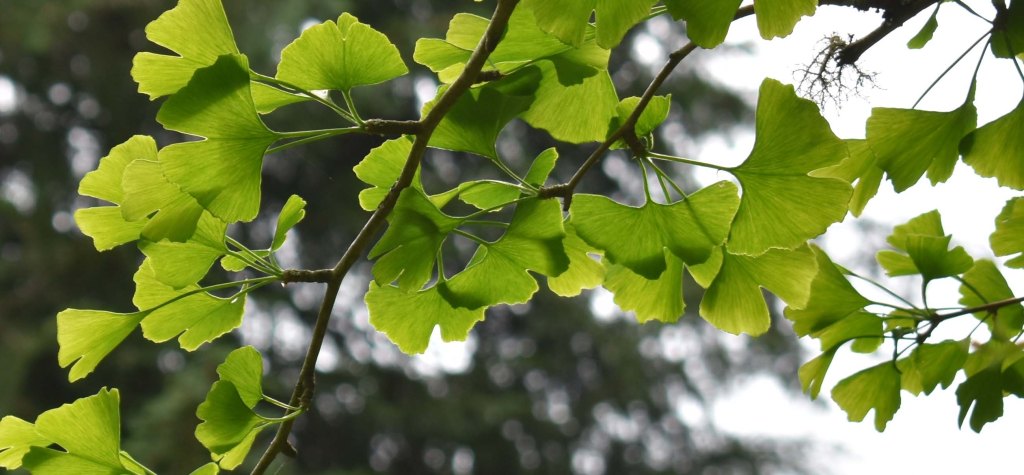
Although they cannot move, plants have better survival strategies for coping with prolonged cold and dark than animals. Some have strong thick roots that are protected from the atmosphere; others have spores or seeds that might remain dormant until suitable conditions return for germination. The plants mostly associated with the Cretaceous are ferns and gymnosperms. The gymnosperms (naked seeds) include the cycads, conifers and ginkgos. The only cycads that we have at Crathes are those in pots in the glasshouses; an attempt to grow them outdoors in the Evolution Garden was defeated by hard frosts.
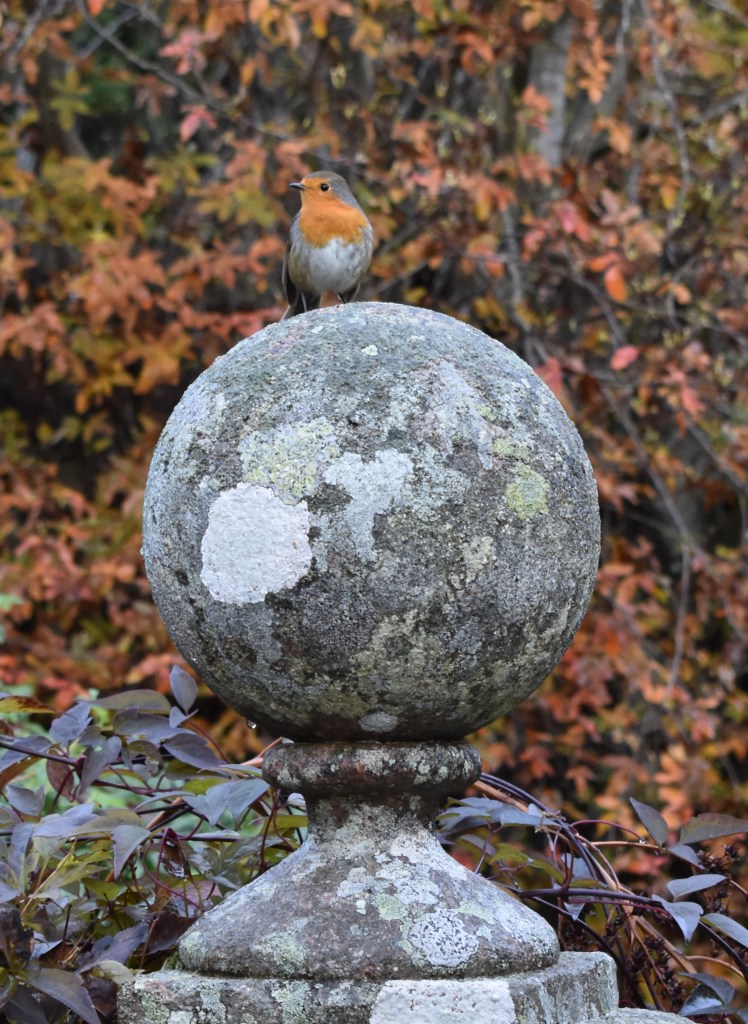
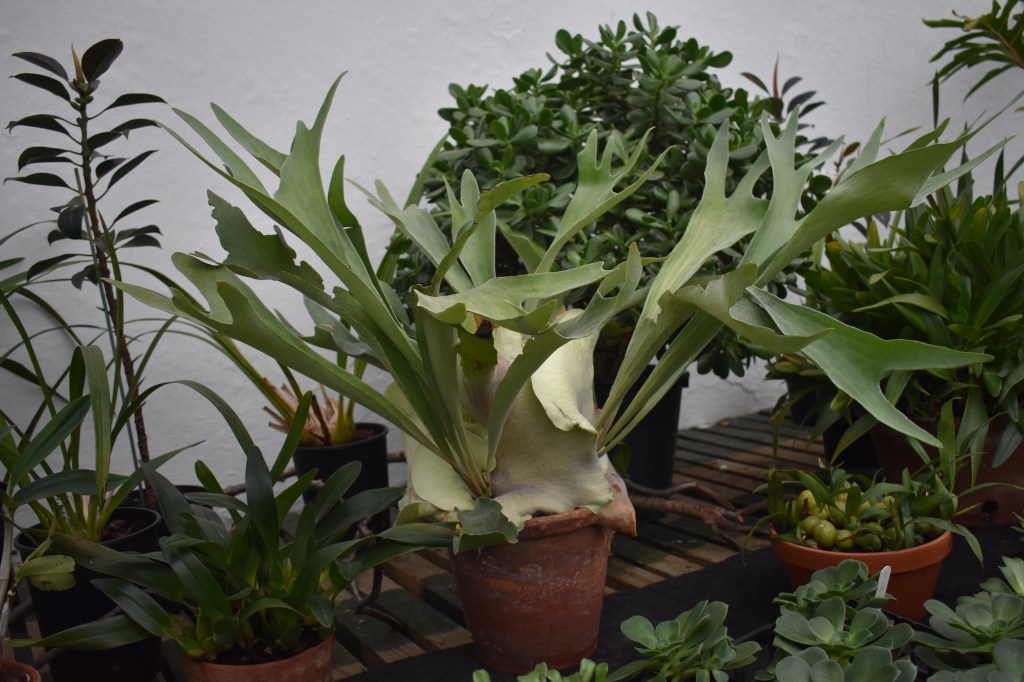
Ferns are still plentiful, many in the Walled Garden, both native and exotic, and many more in the outer estate. The Ginkgo biloba – known as a living fossil – grows at Crathes although not vigorously. Various conifers grow well in the Scottish climate; the only native ones are Scots pine, juniper and yew.
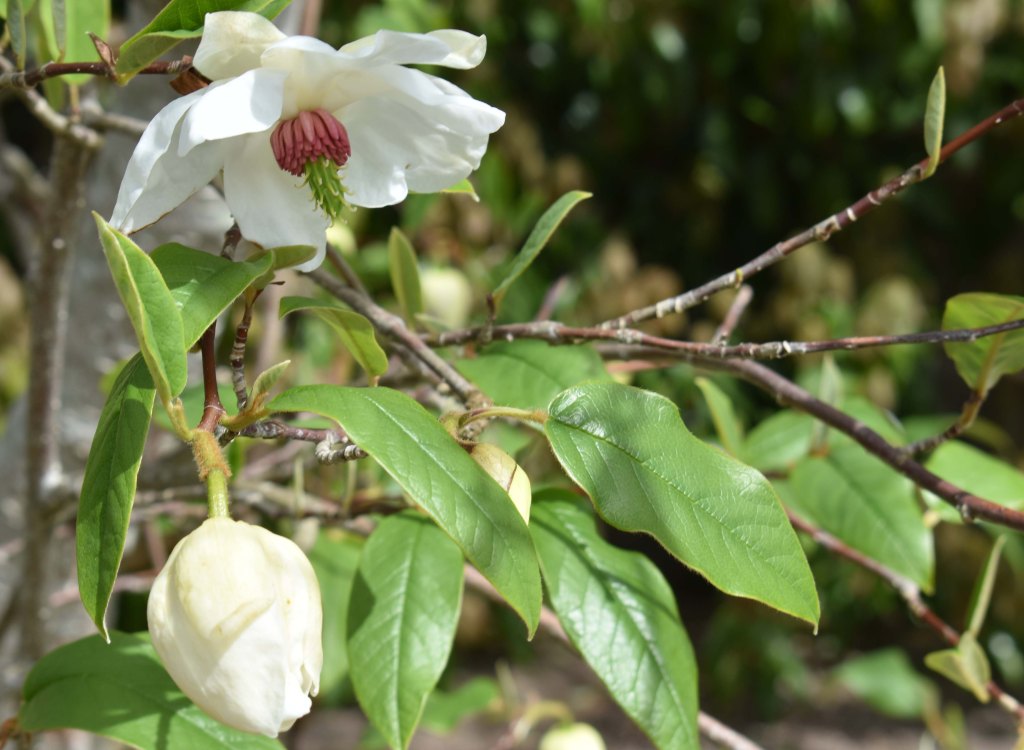
A few angiosperms (seeds protected by fruits – flowering plants) had evolved by the Cretaceous era; magnolias for example have survived and remain successful – they are pollinated by beetles because bees had not evolved in Cretaceous times.
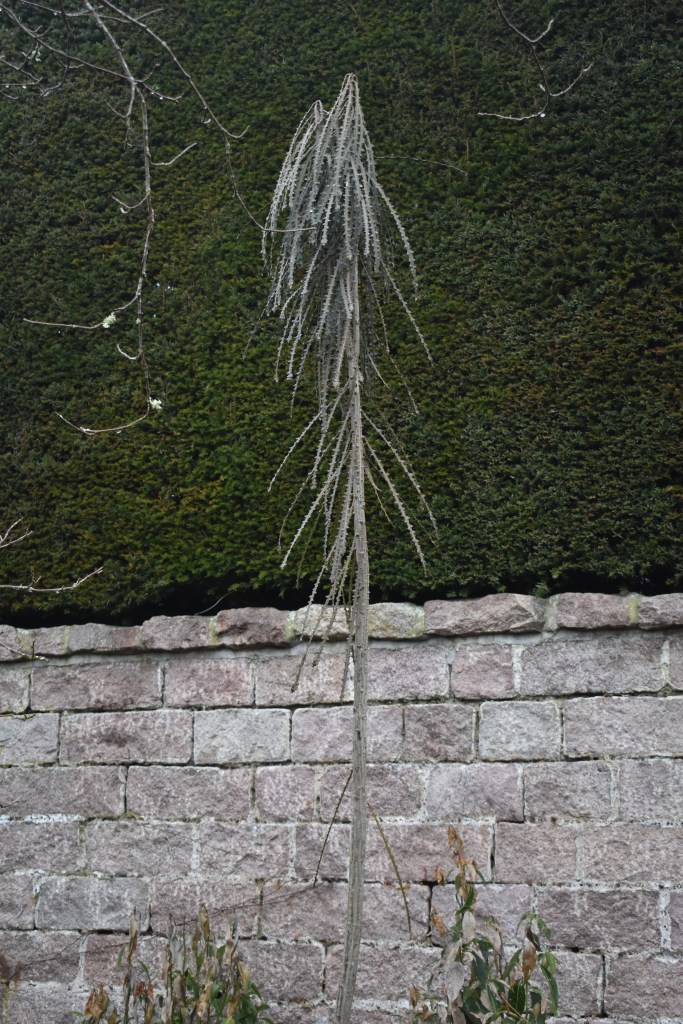
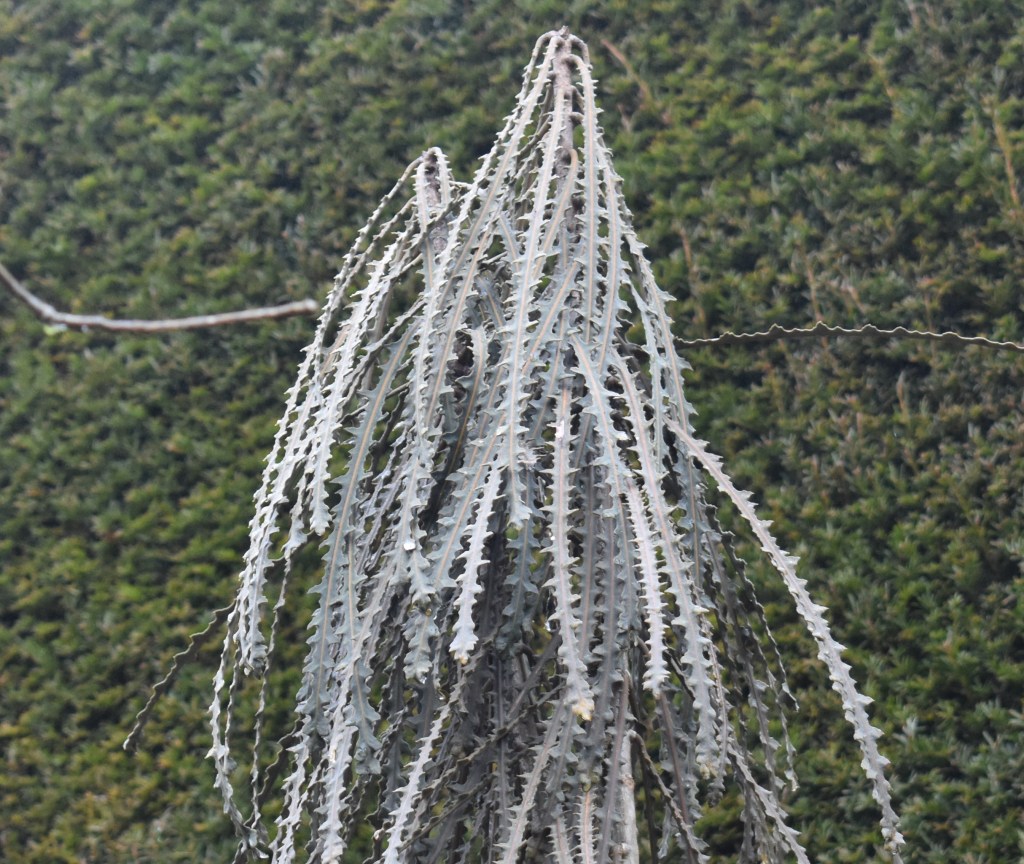
A plant that always intrigues me grows on the Aviary Terrace. The Pseudopanax ferox has a stick-like sort of growth. Like the ivy it belongs to the Araliaceae family. However, when it reaches over three metres in height it apparently begins to change its shape, producing leaves more the shape of those of rhododendrons and branching out. The pseudopanax is native to New Zealand and one theory is that the stick-like, tough, younger leaves protected the tree from moas until the tree grew out of the moas’ reach. Moas are giant flightless birds, rather like large emus, that became extinct fairly recently, probably due to Māori hunters who arrived in New Zealand sometime after the last ice age ended. The plant on the Aviary Terrace is getting quite tall and we wait patiently to see if it will fulfil its expectations.
The most recent ice age ended in Scotland about 10,000 years ago. Just prior to that Scotland would have been under hundreds of metres of ice moving and grinding across the land. As the glaciers moved, so the landscape that we see today was formed. The U-shaped valley of the upper Dee is a typical result of glacial activity. The ancient granite of the Cairngorms and the Dee valley, including the Hill of Fare and Crathes, was eroded by the ice and the glacial moraines that were dumped as the ice melted provided a substrate in which pioneer species like birch, hazel and Scots pine could help to establish new ecosystems with habitats suitable for bears, wolves, beavers, and a whole range of mammals that we have slowly hunted to extinction. Since then we have continued to degrade the planet so much so that we face a critical point in our evolutionary history. If, as scientists think, we are facing the sixth great extinction it will be because of our own actions. We know what we have to do; we have a choice.
However, all is not doom and gloom. I return to the book that I was reading before Christmas – Resilience – which I wrote about in December.** It gives me hope; here is an economist who understands the importance of the natural world, who sees the human species as part of nature. The author, Jeremy Rifkin, president of the Foundation on Economic Trends in Washington DC, is ‘an advisor to the European Union, the People’s Republic of China and heads of state around the world.’ In the age of resilience Rifkin sees a world reconnecting with nature as vital to our survival. The pandemic helped us along that road and Rifkin gives many examples of resilience in action across the globe, often initiated at grass roots by caring communities. I think of our patch. Looking at the whole of the Dee valley it becomes obvious that people working together in partnership have created an accessible area in which we feel we belong. The Dee Catchment Partnership is one of the principal players in caring for our environment, bringing together over twenty organisations (including NTS), representing government, charities, farmers, foresters and private landowners, to improve conservation, accessibility and employment. I have written before about major schemes to bring salmon back to its role as a keystone species for Dee ecosystems (The cycles of life 16 November 2022). There are smaller groups on Deeside also helping to create a healthy world. Places such as The Barn at Woodend, near Crathes, promoting the Arts and letting out allotments; and Seedbox, a charity that has reclaimed the Ballogie Estate walled garden by giving support and horticultural experience to those unable to seek mainstream employment.
Crathes has an important part to play in this narrative about belonging. The property employs staff and provides training. Visitors return again and again to visit the gardens with their beauty, abundance of flowers and pollinators. Thousands use the estate for running, walking their dogs, meeting friends and rambling, boosting their physical and mental health. Schoolchildren visit to learn about frogs and fungi, and the Branching Out group visits to look for new confidence and direction. Volunteers come to give of their time and in return gain friendship and horticultural or ranger skills. Drum and Mar Lodge, also part of the NTS Deeside portfolio have similar responsibilities. Throughout Deeside Scotland’s ‘Right to Roam’ policy underpins our understanding of what it means to belong.
Norman McCaig wrote in his poem ‘A man in Assynt’
Who possesses this landscape? – The man who bought it or I who am possessed by it? False questions, for this landscape is masterless and intractable in any terms that are human.
The land does not belong to anyone; we belong to the land. We may not understand Nature’s complexity but the world is beginning to realise that we must care for it in whatever way we can.
Updates:
Pruning is the focus of work at this time of year.

Cleaning and painting the glasshouses continues. Cleaning the wall in glasshouse 1 for the mineral paint is hard work and time consuming, meaning that Joanna cannot make her usual displays with the paperwhite narcissi.

James Davie and Kevin have been continuing with storm damage clearance.
Mike and Joanna have been working on the iris plants records
- * Otherlands by Thomas Halliday (paperback 2023)
- **The Age of Resilience by Jeremy Rifkin (paperback 2023
 Notes from Crathes
Great work by some great people. We thank you and love our family castle and gardens.
James Burnette
LikeLiked by 1 person
It’s a very special place.
LikeLike
Thank you for yet another very interesting article. The ancient plants are fascinating! In these worrying and challenging times it is uplifting to learn about the many positive things going on!
LikeLike
Without hope we are nowhere!
LikeLike