
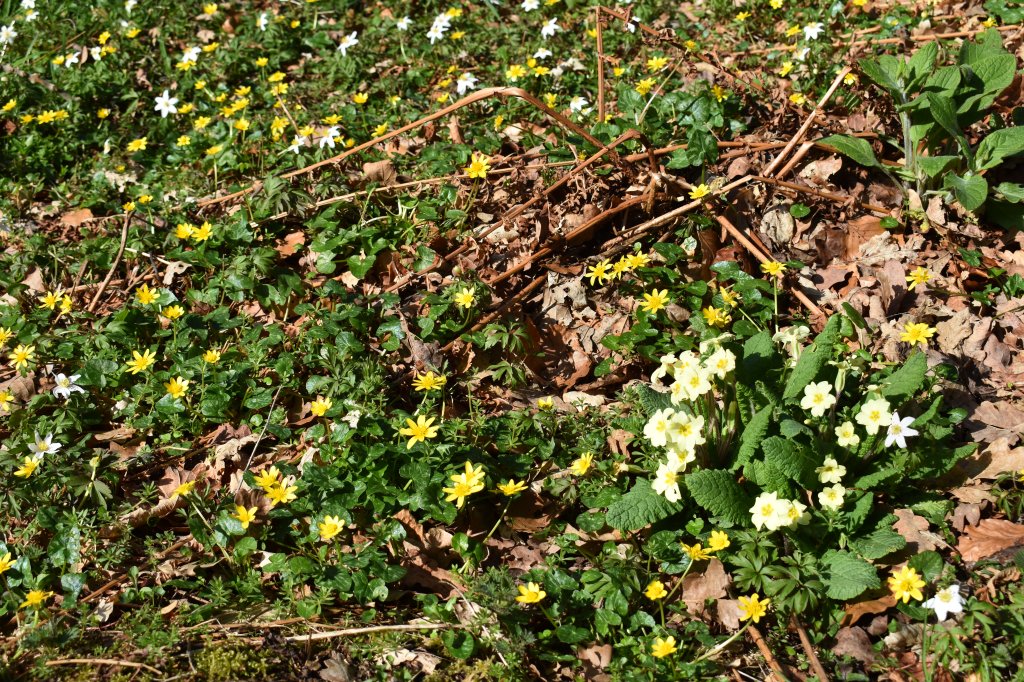
Such a good time of year, April, with all the summer ahead of us. Spring is certainly here but undecided as to whether to stay or not. Despite the cold winds and hail one or two days have been sitting out days; others not so seductive. Mid-April brought one day when the gloves and woolly hat could be cast aside. The celandines and wood anemones were scattering their gold and white charm across the native woodland area with clumps of paler primroses adding a little magic.
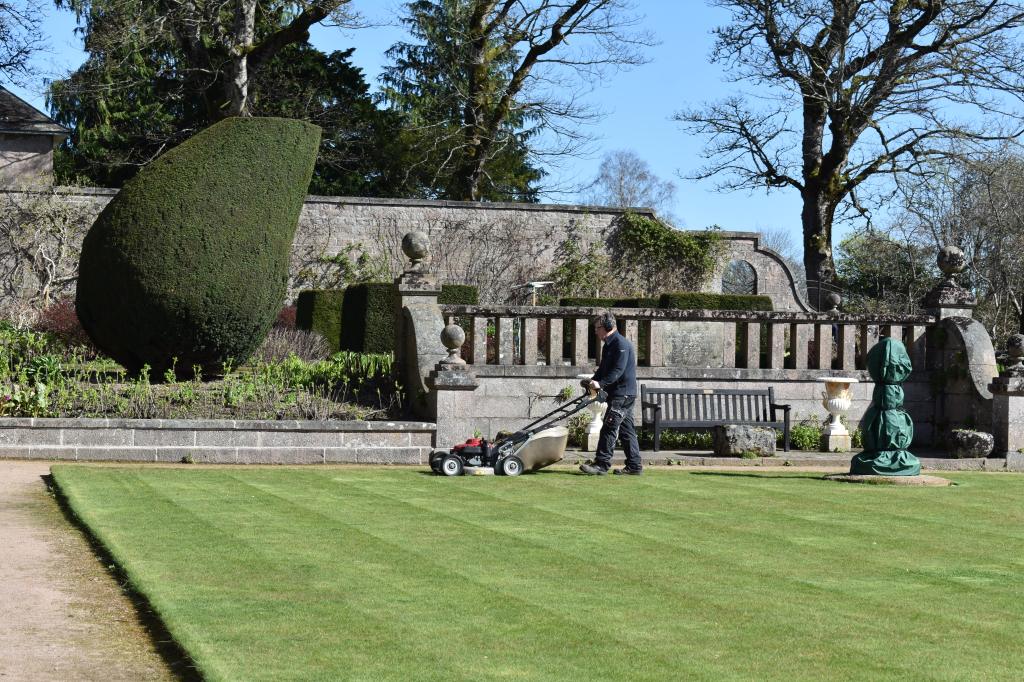
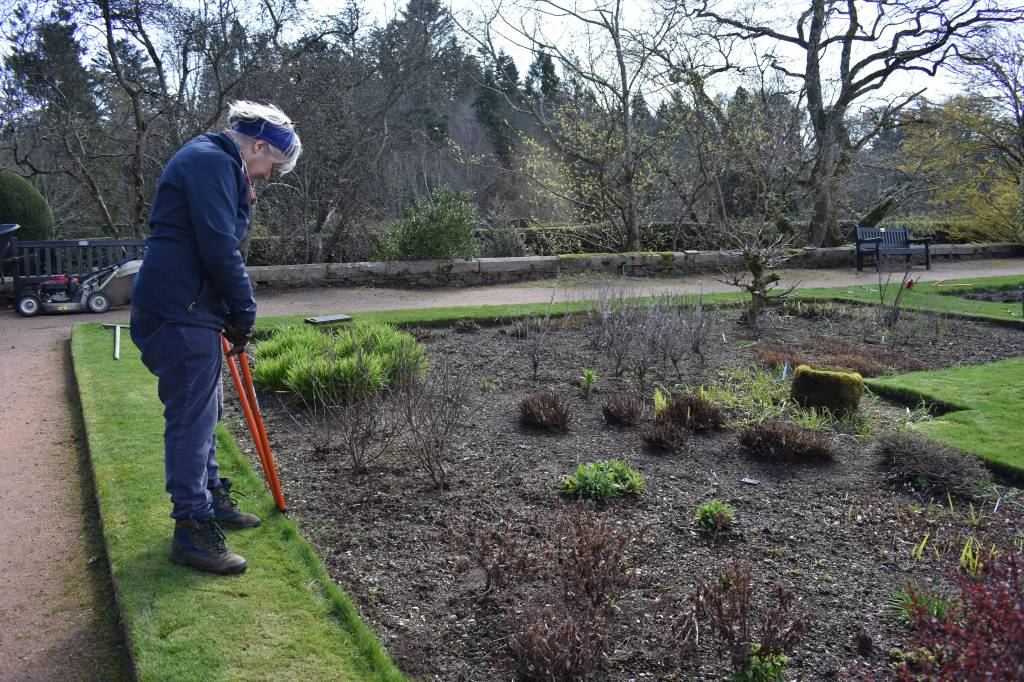
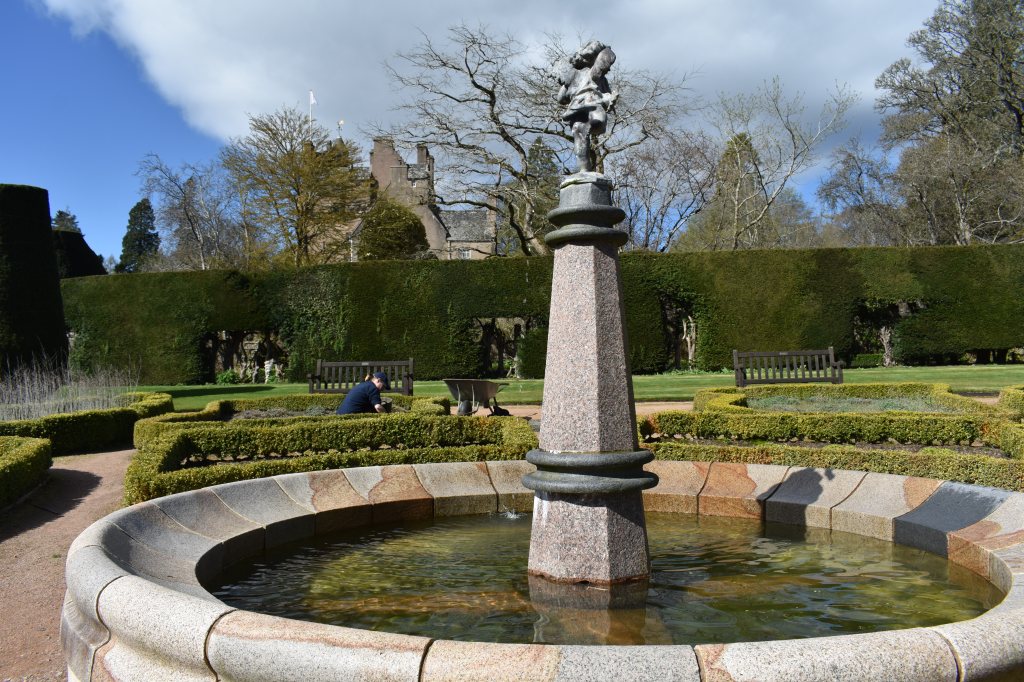
For the gardeners a new tempo is evident with the first cut of the grass and the edging that accompanies the cut. Weeding is becoming more urgent as the thale cress that got out of hand during the Covid years spreads across the Fountain Garden. Judy has it in hand.
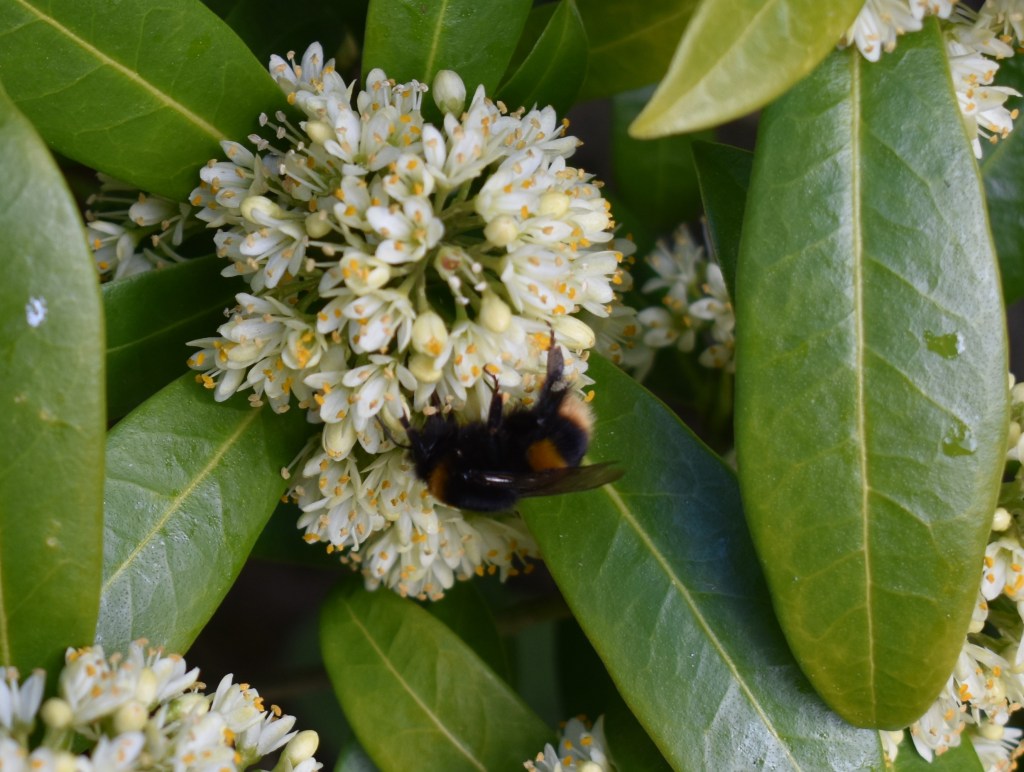
The Skimmia ‘Kew Green’ in the corner of the Fountain Garden is always attractive to insects and this year is no exception. It is covered in solitary bees. I am not an expert on solitary bees but it appears from an identification guide that it is Halictus rubicundus – a mining bee that is widespread in Scotland nesting in sunny banks.* There were bumble bees too on the skimmia but in less quantity
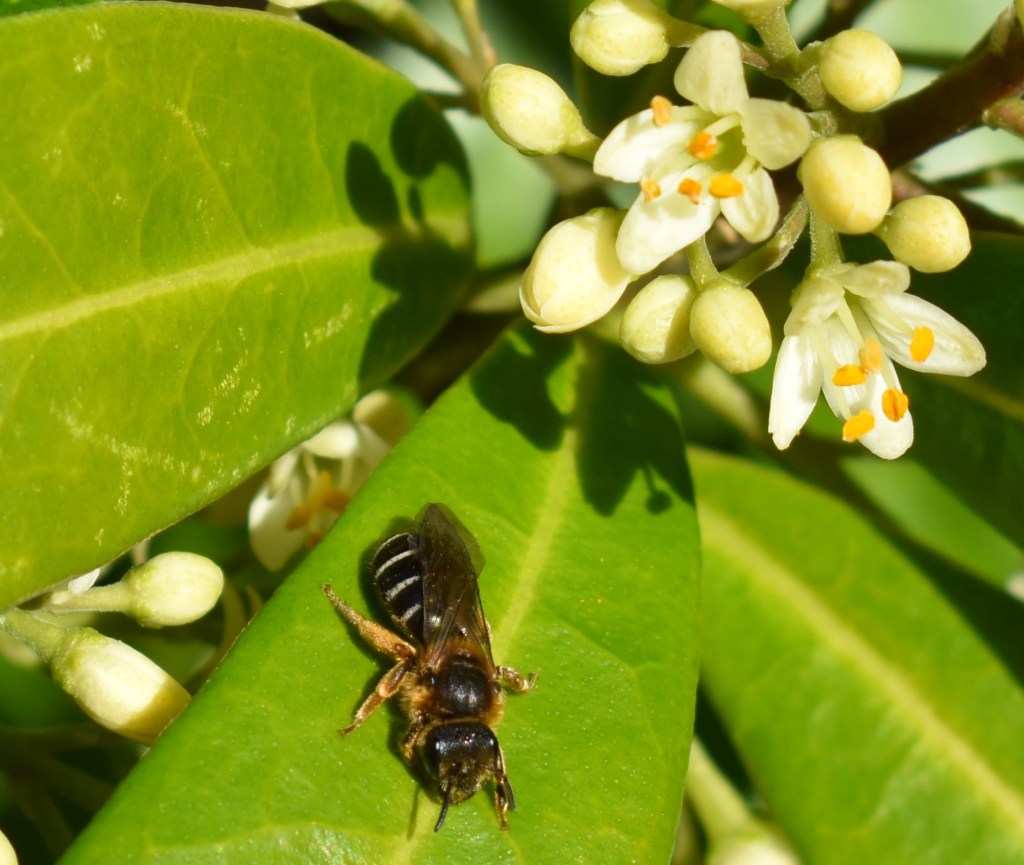
I see from my notes last year (Renewal 23 April 2023) that the skimmia was buzzing with insects then, but not the same ones as this year. The solitary bees were few and not of the same species. I will need to see if I can locate the H. rubicundus nesting area.
Two weeks later and it’s back to the woolly hat and gloves as the sunshine is interspersed with more hail and bitter winds. I can hear the oyster catchers in the Trough Garden, they never seem to give up despite repeated failure. There is not a single solitary bee on the skimmia, but two Bombus terrestris queens are busy gathering nectar.
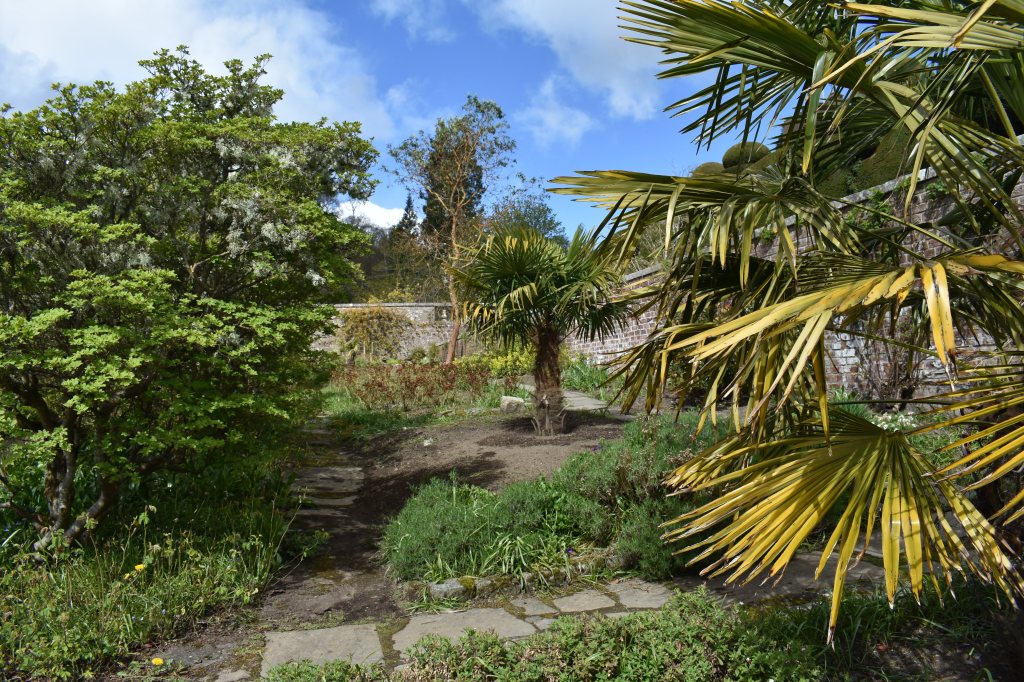
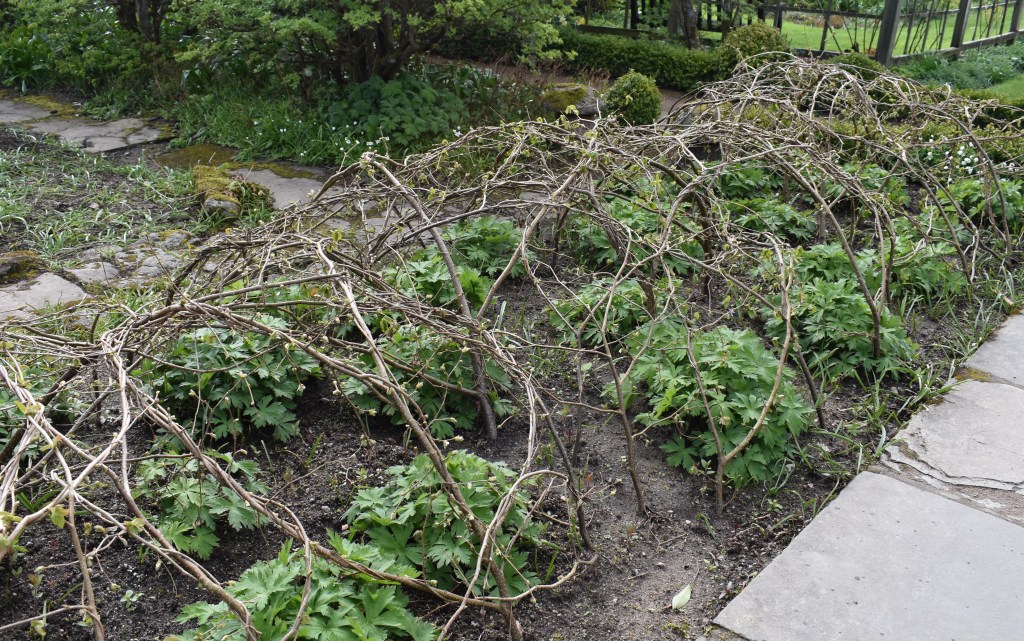
The Chusan palms, Trachycarpus fortunei, from the entrance area have been moved to the more sheltered Four Squares. Mike reports that they were difficult to move. After digging round the root ball it was winched from the ground, using the large Prunus serrula to take the strain, and wrapped in hessian before it was moved to the new site. Mike says he slept well that night. When I caught up with the gardeners Mike and Emily were moving red hot pokers, kniphofias, to be part of the display. Garden snails just love kniphofias; the leaves make good nurseries and perfect hiding places for snails to grow and multiply. We consider the hazel branch supports for the hardy geraniums and wonder if the Geranium psilostemon will manage to grow up through the twigs which are sprouting healthy hazel leaves and look ready to produce a thicket. Geranium psilostemon is a vigorous plant and might well come out tops.

Elsewhere in the garden the magnolias are making a show. The Magnolia soulangeana ‘Burgundy’ in the Rose Garden is noticibly fine, partly because the Chilean fire bush, Embothrium coccineum was damage in the storms and had to be reduced in height. As always in gardens one disaster presents opportunities – although the fire bush was rather special this far north and is resprouting from its base.

Steve and Emily have been at Inverewe for a week. These visits are for training and for exchange of ideas. A tour of the rhododendrons, for which Inverewe is famous, was obligatory – they are at their peak just now. Steve was introduced to some new machinery, but his main interest was that of compost making. Crathes makes really good compost but is rather troubled by weed seeds. Inverewe has a scientific approach to composting, devoting time to taking regular temperature readings and recording organisms found in the compost using a microscope. This means that they do not have much of a problem with weed seeds. On the other hand Inverewe does not make its own seed compost using a steriliser like we do at Crathes. Steve thinks Crathes could benefit from turning the compost beds more frequently, making sure that plenty of air is introduced into the rotting process; another benefit could be gained by a cover of some sort (maybe felt) that would increase the temperature of the heaps. If the temperature rises there will be less surviving weed seeds meaning less weeding. Our volunteers are brilliant weeders but it is always hard work and a never ending task.
Emily was also interested in the composting but her main focus was regarding fruit pruning. James has a mind to bring the apple trees in the nursery back into production. Although the Inverewe apples had already been pruned Emily was talked through the process and had hands on experience with the soft fruit. At the same time she was picking up ideas for growing vegetables that will come in useful for her own garden, and possibly at some point in the future.
Crathes is fortunate being a garden of The National Trust for Scotland because exchange of staff between properties provides free training and works both ways. Kirsten came from Crarae this month to learn about glasshouse management from Joanna so that the empty glasshouse at Crarae can be used.
But there is much to learn from other sources too: James is expecting to learn something when people from Scotland’s Yew Tree Heritage Initiative visit this week to measure our ancient yews; Joanna is hoping to go to Logan Gardens on the Rhins of Galloway (Royal Botanic Garden Edinburgh) in September to learn something from glasshouse practice there; Mike is planning to visit some gardens on the west coast when he is on holiday in the summer. He is especially interested in herbaceous plants. Since this is part of his professional development he will get some time off in lieu. Specialist courses are also available – James has been on a tree surgeon course, and hopes to go on a lime mortar course to help him deal with the old walls at Crathes. Steve, Mike, Emily and Kevin were on a first aid course last week that emphasised the proper response to chain saw accidents. Much of training goes along with day-to-day practice. James tries to give everyone some experience of the main garden activities such as cutting the grass and hedge trimming. The volunteers who give so many dedicated hours to the garden also learn on the job – the diversity of plants at Crathes provides everyone with good experience.
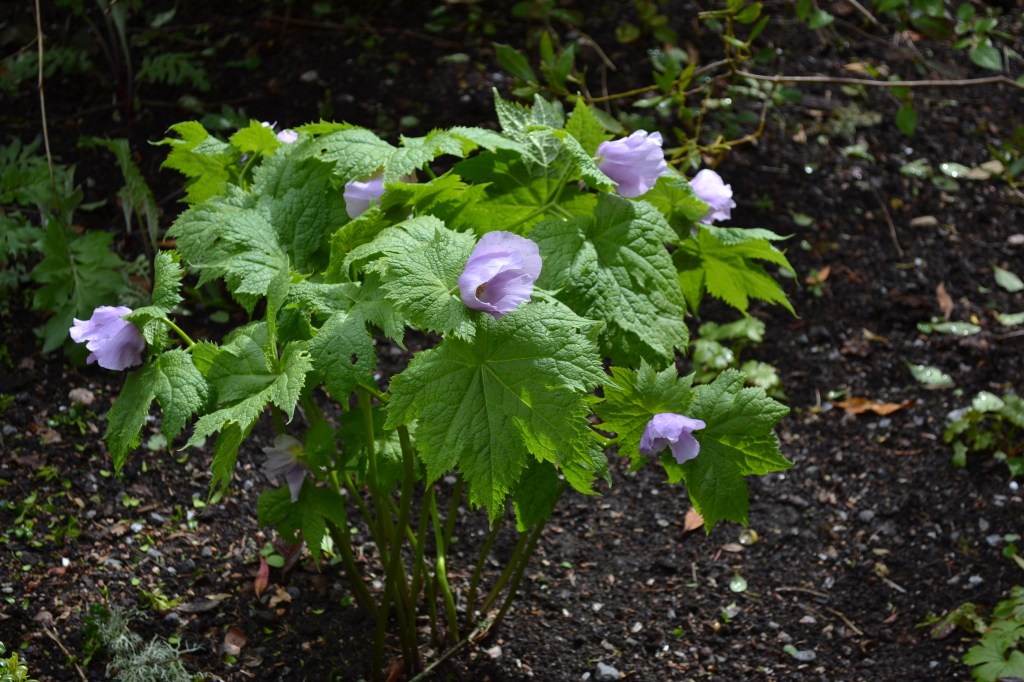
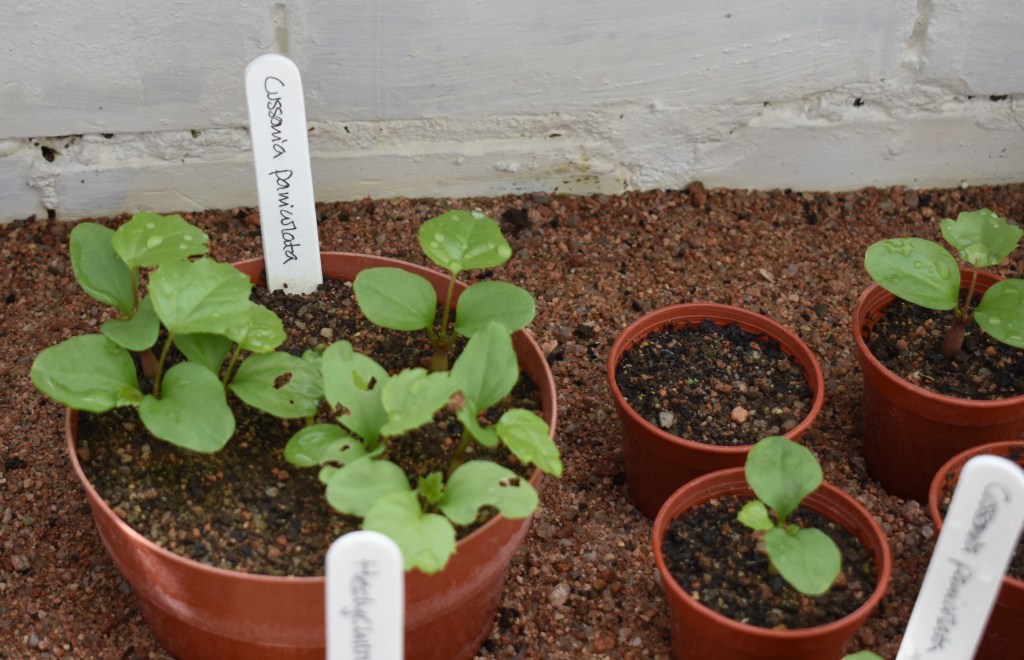
Plants are at the heart of the garden and learning plant names is ongoing for us all; sometime just reminding ourselves, sometimes having to learn completely new names. Glaucidium palmatum on the South Border was puzzling people at lunch break this week. Also known as the Japanese Wood Poppy, it belongs to the Ranunculaceae (buttercup) family. I forgot to go and look at it but find I have a photo taken in 2017. James and Joanna were recently in Fife buying new plants so there will be more challenges ahead; new varieties of meconopsis have been mentioned. Presently they are in the nursery in quarantine. Joanna has new seeds germinating in the glasshouse which I will have to learn. On googling Cussonia paniculata I am surprised to find it is a small tree native to South Africa. Considered to be a pachycaul (swollen stemmed) succulent, it will apparently store water in the swollen stem base which develops quite early in its growth. I imagine it is not expected to become a tree at Crathes, but just an interesting glasshouse plant. The seedlings look strong and healthy so I can follow its development. Will I remember its name?
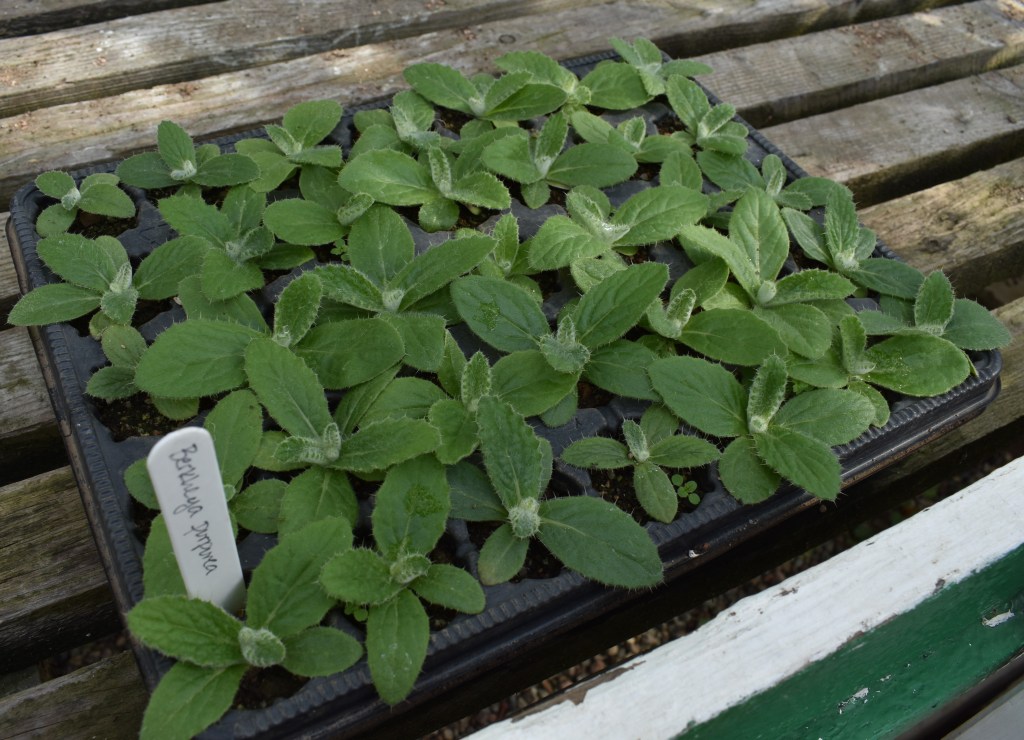
There is the usual mixed germination on the propagating bench (the white sweet peas never seem to do well) but the Berkheya purpurea from Crathes seed have excelled themselves. I think they are to go along the wall where the arbutus fell in Storm Arwen.
Running the garden is about balancing the immediate requirements for this year’s display and the needs of the future; not just growing plants but seeing to maintenance issues so that budgets will not be overloaded at a later date. Training is a vital part of the garden development. Ultimately, the thought put in today is reflected in the garden displays yet to come.
Updates:
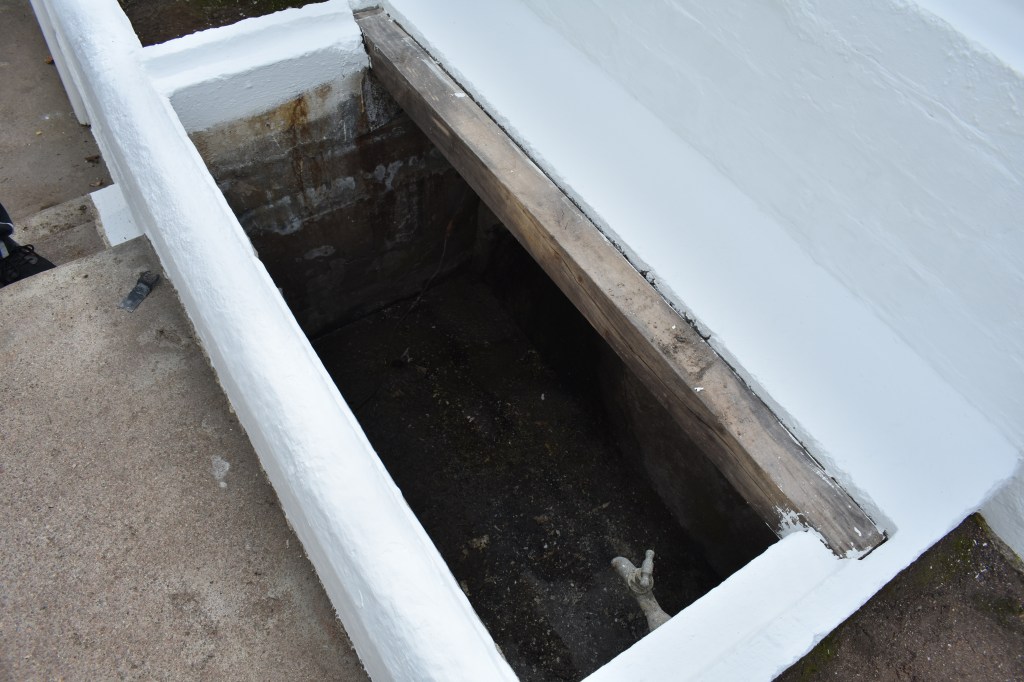
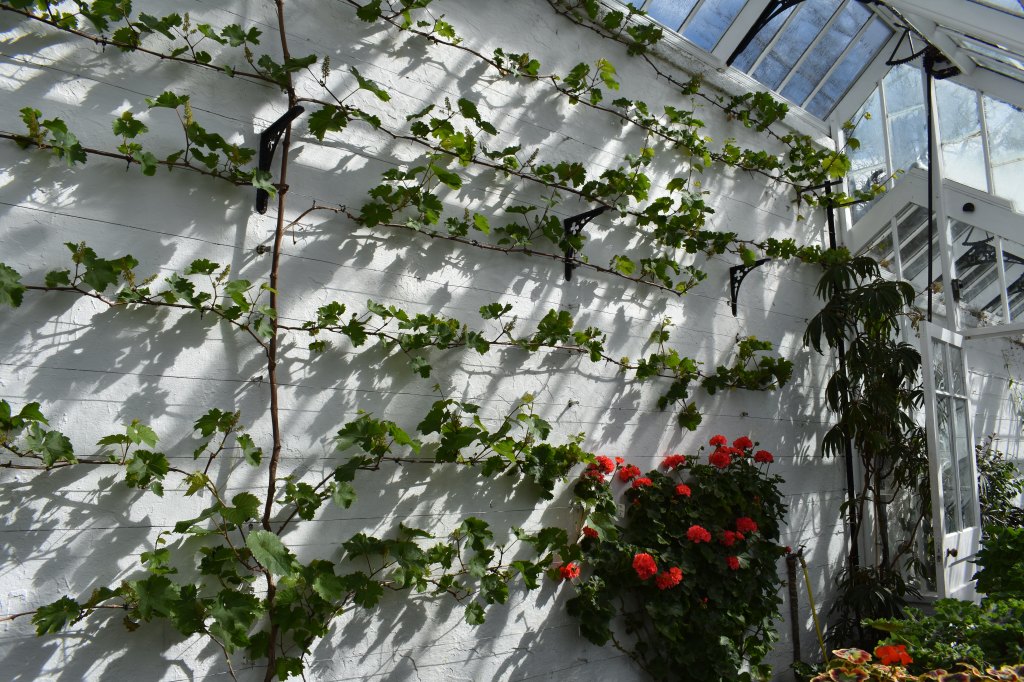
Maintenance continues in the glasshouses with glasshouse one still waiting for its staging and some more repair work. The old water tank will be refilled because the large volume of water helps to stabilise the temperature, rather like a storage heater. Because of the maintenance work the glasshouses are not open, though full of plants ready for the season. The vinery looks good with its pelargoniums and the new vine trained for display rather than for fruit.

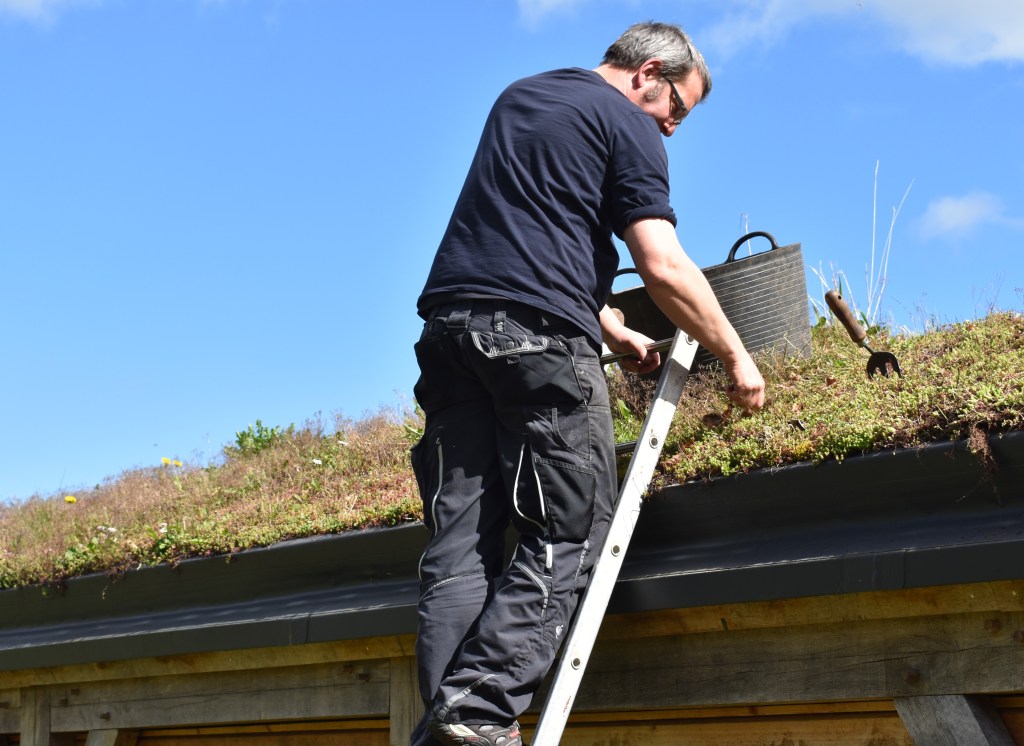
James has been weeding the roof of the entrance building. The dandelions like it up there, but for the meantime they are not welcome.
The recently released wildcat (Willie) that travelled from Strathspey to Deeside last autumn is still on Deeside (see Time slips by posted 27 February 2024). Initially settling on the Mar Lodge Estate, resting in rough windblown areas and feeding on field voles beside the river, he then moved down to the Invercauld Estate which has a plentiful supply of rabbits. You can follow his adventures on the Saving Wildcats website.
A disease that affects Scot’s pine and has been known to be troublesome in the past has now spread throughout Scotland. The fungus Curreya pithyophila, in association with an aphid like insect is causing the damage. It looks like a large black canker or lichen and causes branches to die.
*Wild Bees of Scotland Identification Guide – Scottish Natural Heritage (now NatureScot)
 Notes from Crathes
Thank you again for another very informative and interesting article. It is a busy time of year with everything burgeoning although I feel some things are earlier than usual. The bumble bees in our garden are out in force! As well as other flowering plants, the dandelions look glorious but need dealing with again! We will need to watch out for bykes as there have been a couple of queen wasps exploring the premises. Better and busier days ahead!
LikeLiked by 1 person
Thanks Jenny. A glorious couple days here has brought the tulips out and raised the spirits. I’m hoping our resident blackbirds will reduce the slug population.
LikeLike